

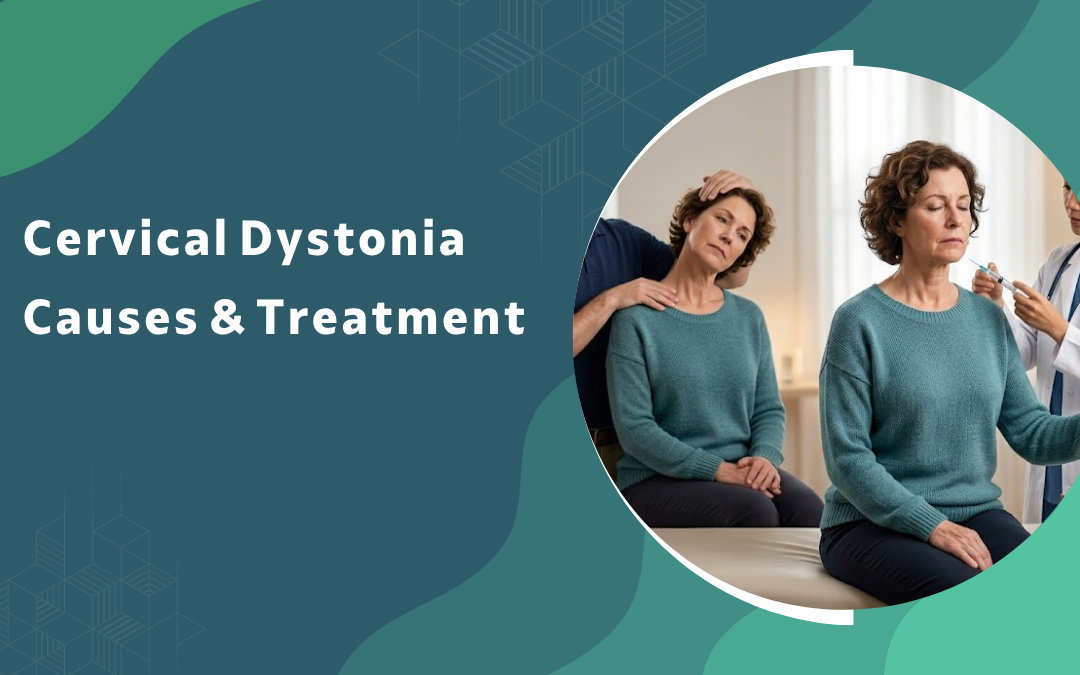
Cervical dystonia, also called spasmodic torticollis, is a chronic neurological disorder where involuntary neck muscle contractions cause abnormal head tilting, twisting, and pain.
There is no cure, but treatment effectively manages symptoms through botulinum toxin injections every 3 months, oral muscle relaxants, physical therapy, and surgery in drug-resistant cases. It affects roughly 60,000 people in the US and most patients first notice it somewhere between 40 and 60. Women, for whatever reason, get it nearly twice as often.
According to Dr. Gurneet Singh Sawhney, dystonia treatment, Botox works for most patients, no question. But the moment injections stop holding or doses keep going up, that’s when DBS surgery becomes the better answer.
Neck won’t stop pulling? Pain getting worse every month?
What causes cervical dystonia and who's at risk?
The basal ganglia misfires. Wrong signals go to neck muscles, they contract when they shouldn’t, and the head twists. Why it starts in any specific person, often nobody can say.
- Genetics: Roughly 10 to 15% of patients have a family history. THAP1, TOR1A, a few others. Most patients though, no genetic link shows up at all
- Trauma: A whiplash from years back, an old fall, sometimes a surgery. The connection isn’t always clean but it’s there often enough that doctors ask
- Drug-induced: Antipsychotics taken long-term. Some anti-nausea meds too. This version, called tardive dystonia, is harder to reverse than the regular kind
- Demographics: Forties and fifties is the typical window. And women, as mentioned, get it disproportionately
So for most patients the trigger is a guess at best. Diagnosis comes through MRI, a thorough history, sometimes blood work and genetic panels. Persistent neck spasms, family history, anything that’s been bothering you for months really, those are reasons to see a functional neurosurgery specialist and not wait it out.
How is cervical dystonia treated and when is surgery needed?
Treatment escalates. Patient starts on the gentler stuff, sees what works, moves up the ladder if it doesn’t.
Treatment | What It Does | When It’s Used |
Botox injections | Blocks nerve signals | First-line, every 3 months |
Oral medications | Relaxes muscles | Mild cases, side effects common |
Physical therapy | Strengthens posture | Adjunct therapy always |
DBS surgery | Resets brain circuits | Severe, drug-resistant cases |
Botox handles probably 70% of cases reasonably well. Where it falls apart is when injections stop holding the way they used to, or when the dose creeps higher every cycle. That’s the trigger point for surgery talk. DBS puts electrodes in the globus pallidus internus, runs them off a chest pacemaker, and gives somewhere between 50 to 70% improvement inside half a year for most patients. Some respond bigger. A few less. For older patients, or those who’d rather avoid brain surgery entirely, selective peripheral denervation is a real option, and pallidotomy too in select cases.
Surgery isn’t where you start. But for patients stuck at the end of the medical road, it’s often what gets them their life back.
Why Choose Dr. Gurneet Singh Sawhney
Dr. Gurneet Singh Sawhney brings 18+ years of neurosurgical work, plus fellowship training in Functional Neurosurgery from Tokyo Women’s Medical University in Japan. The kind of complex movement disorder cases that get bounced around between hospitals, that’s where Dr. Gurneet Singh Sawhney tends to actually take them on. DBS, lesioning, stereotactic procedures, all of it under one roof.
Surgery’s not pushed here. Medical options first, always. And when DBS does become the right call, the track record speaks louder than any pitch. Hundreds of dystonia and Parkinson’s patients functional again. That’s what matters.
FAQ's
What's the difference between cervical dystonia and torticollis?
Same thing. Torticollis is just what it used to be called.
Can cervical dystonia go away on its own?
Less than 20% of patients get spontaneous remission, and most of those see it return.
How long do Botox injections last for neck dystonia?
Around 10 to 12 weeks per cycle, then re-injection.
Is DBS surgery permanent for cervical dystonia?
The device stays for life but it’s adjustable, switchable, removable anytime.