


A neuropsychological evaluation before brain surgery measures memory, language, attention, executive function, and visuospatial ability to establish a precise pre-operative baseline. It identifies which functions are already impaired and which are at risk from the planned approach. In epilepsy surgery, awake craniotomy, tumour resection near eloquent areas, and deep brain stimulation candidacy, it directly changes what surgery is offered and how it’s planned.
According to Dr. Gurneet Singh Sawhney, a leading neurosurgeon in Mumbai, “A neuropsychological evaluation tells you where the patient’s cognitive vulnerabilities already are before surgery that’s the baseline you’re trying to protect, not the textbook average for someone their age.”
Scheduled for brain surgery near language, memory, or motor areas and haven’t had cognitive testing yet?
What Does a Neuropsychological Evaluation Actually Test Before Surgery?
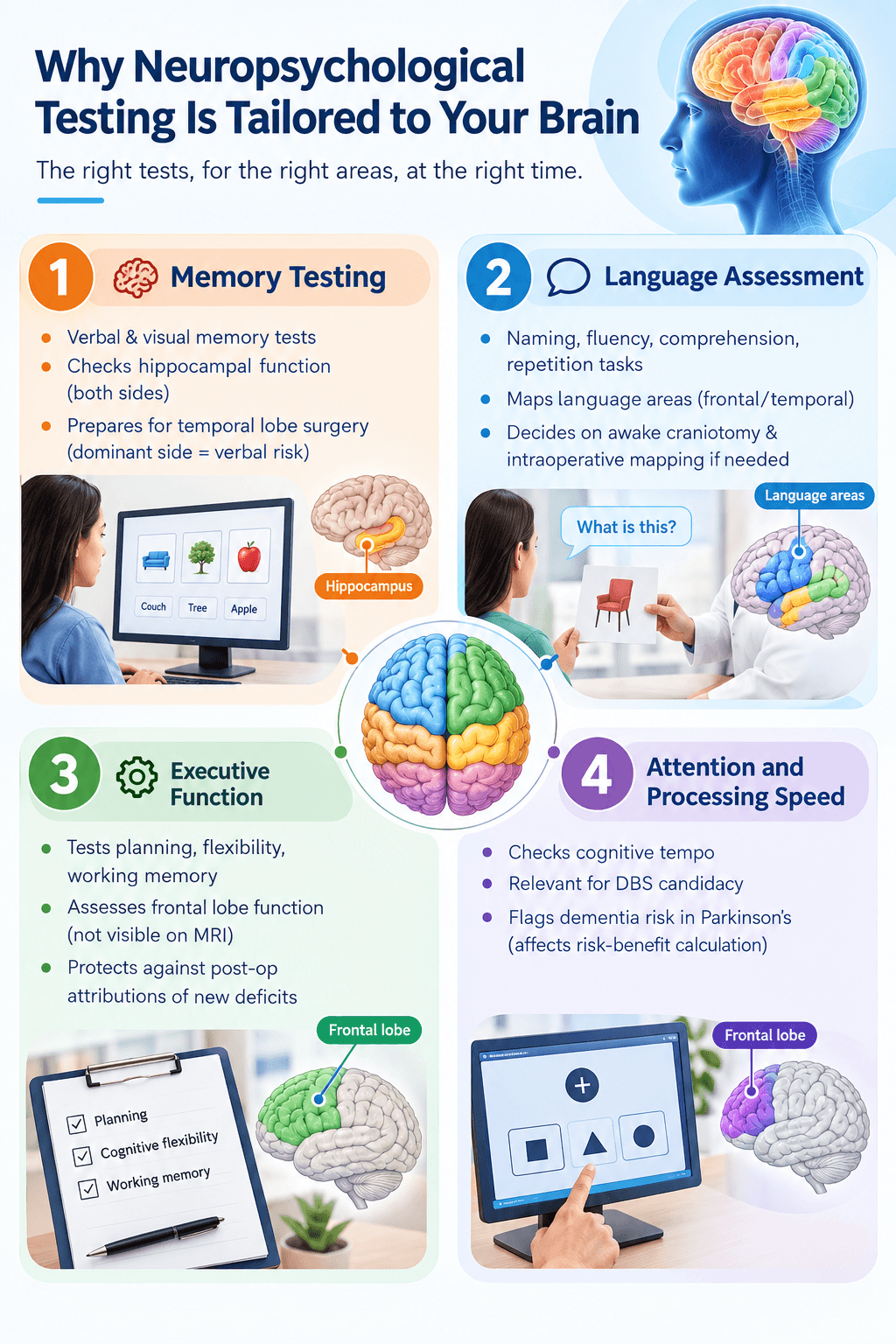
The full battery takes three to five hours and is administered by a clinical neuropsychologist. Findings feed directly into operative planning for brain surgery near eloquent areas.
How Neuropsychological Results Change Surgical Planning and Consent?
The evaluation is a clinical decision tool it materially alters what surgery is planned and how consent is conducted.
- Lateralisation decisions: In temporal lobe epilepsy, if dominant hemisphere memory is already significantly impaired, the team may extend hippocampal resection further or conversely plan a more conservative resection if memory is unexpectedly preserved. MRI alone can’t make this call.
- Awake craniotomy indication: When a tumour sits adjacent to the language cortex, a neuropsychological baseline combined with functional MRI determines whether awake craniotomy is necessary, not surgeon preference.
- DBS candidacy filter: Significant cognitive decline or frontal executive dysfunction identified pre-operatively can exclude a patient from DBS regardless of how well their motor symptoms fit the criteria cognitive risk outweighs motor benefit.
- Informed consent specificity: Results allow the team to tell the patient specifically which cognitive functions are at risk, at what probability, based on their own baseline not population averages. That’s the only version that constitutes genuine informed consent for cognitive risk.
Postoperatively, the same battery is repeated at 6 to 12 months to objectively assess whether the procedure preserved, improved, or altered cognitive function. For a detailed look at where pre-surgical evaluation is most protocol-critical, see deep brain stimulation for Parkinson’s.
Why Choose Dr. Gurneet Singh Sawhney?
Dr. Gurneet Singh Sawhney holds MBBS, MS (General Surgery), and MCh (Neurosurgery) ranking first in the MCh university examination with fellowship training in Functional Neurosurgery under Prof. Taira at Tokyo Women’s Medical University and Epilepsy Surgery under Prof. Sugano at Juntendo University Japan, covering brain tumour resection, temporal lobe epilepsy surgery, awake craniotomy, and DBS all procedures where pre-surgical neuropsychological evaluation is a mandatory planning step rather than an administrative requirement.
Pre-surgical cognitive evaluation in his practice is reviewed before the operative plan is finalised because the neuropsychological baseline shapes what surgery is offered, not what’s disclosed afterward.
Frequently Asked Questions
Is a neuropsychological evaluation required before all brain surgeries?
Not all it’s mandatory before epilepsy surgery, awake craniotomy, DBS, and resections near eloquent cortex.
How long does a pre-surgical neuropsychological evaluation take?
The full battery typically takes three to five hours, administered across one or two sessions.
Can neuropsychological testing predict memory loss after temporal lobe surgery?
Yes, pre-operative memory lateralisation testing directly predicts post-operative verbal memory risk in dominant hemisphere cases.
Is neuropsychological testing repeated after surgery?
Yes post-operative testing at six to twelve months objectively measures cognitive change against the pre-surgical baseline.
Disclaimer: The information shared in this content is for educational purposes only and not for promotional use.