

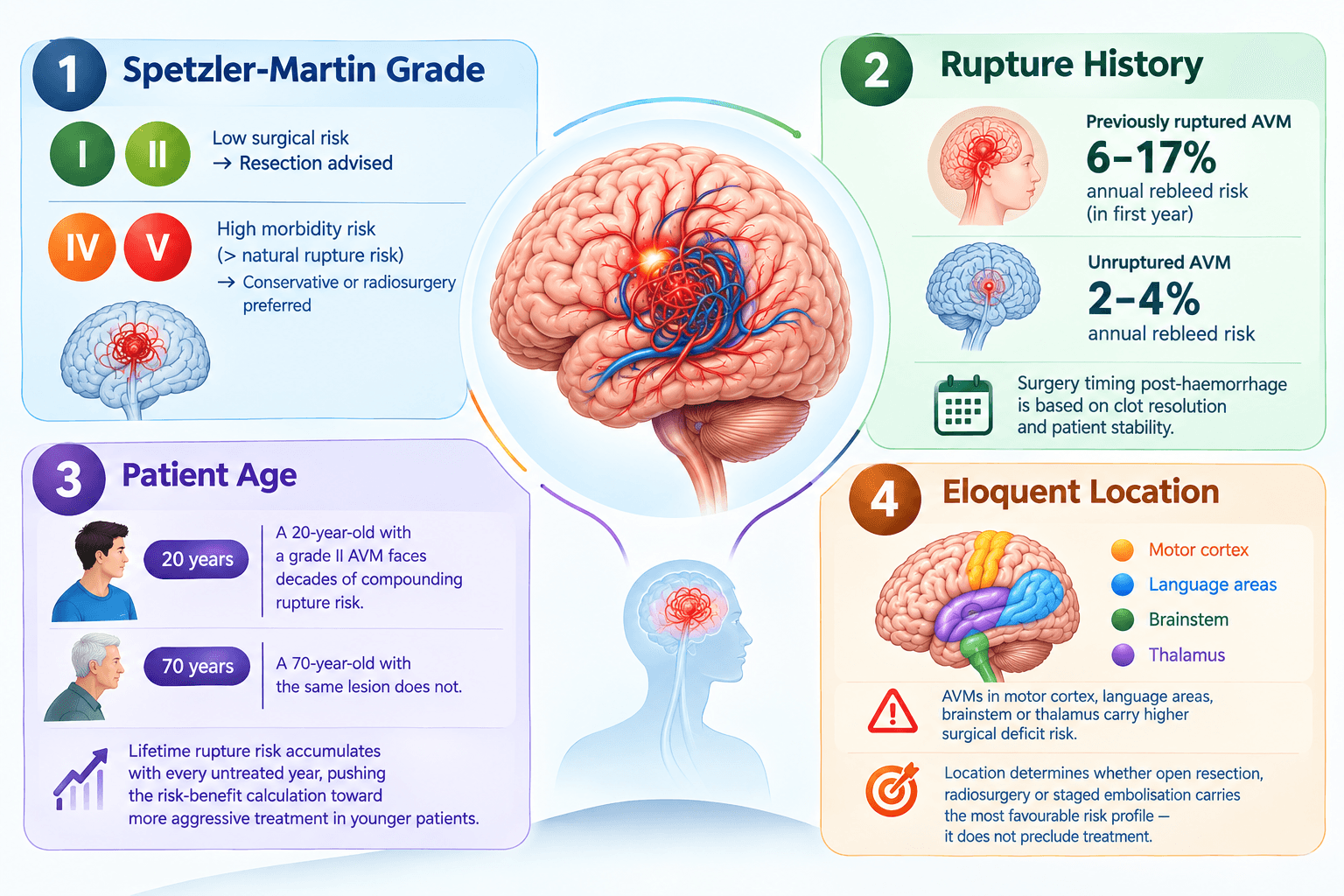
Operating on a brain AVM isn’t a reflex it’s a risk calculation. The Spetzler-Martin grade (size, location, venous drainage pattern) anchors the decision, but patient age, neurological status, and prior rupture history all shift the calculus. Not every AVM needs treatment, and not every AVM that needs treatment needs open surgery. Microsurgical resection, stereotactic radiosurgery, endovascular embolisation, and combinations of all three each have their place. Choose wrong, and the treatment carries higher morbidity than the lesion itself.
According to Dr. Gurneet Singh Sawhney, a trusted spine specialist in Mumbai, “A Spetzler-Martin grade I or II AVM in an accessible location should almost always be treated the lifetime rupture risk outweighs the surgical risk. Grade IV and V AVMs in eloquent areas are a different conversation entirely.”
Diagnosed with a brain AVM and uncertain whether surgery is the right next step?
What Determines Whether a Brain AVM Should Be Operated On?
Treatment decisions require multidisciplinary input across neurosurgery, interventional neuroradiology, and radiosurgery. Imaging workup and cortical mapping overlap closely with those used in brain tumor surgery for eloquent-location lesions.
What Treatment Options Exist and How Each Is Selected?
Microsurgical resection: Achieves immediate obliteration and eliminates rupture risk from day one preferred for low-grade accessible AVMs. Cure is confirmed with intraoperative ICG angiography and post-operative DSA.
Stereotactic radiosurgery: Gamma Knife or CyberKnife induces obliteration over two to four years. Appropriate for small deep AVMs under three centimetres but the patient remains at rupture risk throughout the latency period.
Endovascular embolisation: Reduces blood flow and nidus volume before surgery or radiosurgery. Rarely curative as a standalone treatment used as an adjunct to reduce intraoperative bleeding or occlude deep feeders.
Conservative management: Grade IV and V AVMs may carry treatment risks exceeding natural history risk. Functional neurosurgery principles guide how much eloquent cortex can be preserved; annual imaging observation is a legitimate strategy, not a failure to act.
For foundational context on rupture risk and natural history, read AVM vs Aneurysm vs Cavernoma: What’s the Difference.
Why Choose Dr. Gurneet Singh Sawhney?
Dr. Gurneet Singh Sawhney holds MBBS, MS (General Surgery), and MCh (Neurosurgery), ranking first in the MCh university examination with specialised expertise in Vascular Neurosurgery, including hundreds of AVM and aneurysm surgeries, fellowship training in Functional Neurosurgery from Japan, and over 18 years of surgical experience managing the full spectrum of cerebrovascular pathology from low-grade accessible AVMs through complex deep-seated lesions requiring multidisciplinary planning.
His AVM assessment process begins with DSA review before any treatment recommendation is made because grade, anatomy, and patient profile together determine the approach, and no two AVMs present the same surgical problem.
Frequently Asked Questions
Does every brain AVM need surgery?
No, treatment depends on Spetzler-Martin grade, location, rupture history, and patient age.
How long does radiosurgery take to obliterate a brain AVM?
Radiosurgery achieves progressive obliteration over two to four years, with rupture risk persisting throughout.
Is embolisation alone enough to treat a brain AVM?
Rarely is embolisation is usually an adjunct to surgery or radiosurgery, not a standalone curative treatment.
What is the annual rupture risk of an untreated brain AVM?
Unruptured AVMs carry approximately two to four percent annual rupture risk; previously bled AVMs carry significantly higher risk.
Disclaimer: The information shared in this content is for educational purposes only and not for promotional use.