

Every patient scheduled for brain or spine surgery has the right to clear, specific answers before signing a consent form and the quality of those answers reveals as much about the surgeon as the diagnosis itself. The questions that matter aren’t about reassurance. They’re about surgical indication, anatomy-specific risks, what happens if surgery is declined, and how outcome is measured. A surgeon who answers precisely, without deflecting to generalities, has planned the case rather than templated it.
According to Dr. Gurneet Singh Sawhney, a leading spine surgeon in Mumbai, “The best pre-surgical consultation is one where the patient leaves with answers, not just a surgery date. If a patient can’t explain why they need this operation and what the alternative is, the informed consent process hasn’t been completed.”
Scheduled for brain or spine surgery and still unclear on the specific risks to your case?
What to Ask About the Diagnosis and Surgical Indication?
The full scope of surgical options is covered through brain surgery consultation pathways that include pre-operative imaging review.
What to Ask About Surgical Risk, Recovery, and Outcomes?
Generic risk percentages aren’t useful the questions that matter extract risks specific to the patient’s anatomy, age, and the surgeon’s own practice data.
- Anatomy-specific risk: The question isn’t “what are the risks of this surgery” it’s “what are the risks on my imaging, at my age, given my comorbidities.” A cervical fusion in an eighty-year-old with osteoporosis carries different hardware failure risk than the same procedure in a forty-year-old.
- Deficit risk: For any surgery near eloquent cortex, language areas, or nerve roots, ask specifically what neurological function is at risk and how that risk is mitigated. Awake craniotomy, neuromonitoring, and cortical mapping are answers that reflect a planned approach functional neurosurgery principles govern how these protections are built into the operative plan.
- Surgeon volume: How many times a surgeon has performed this specific procedure at this specific level is a legitimate question. A specific number demonstrates the kind of precision that should extend to the operating room.
- Recovery timeline: The answer should be specific when weight-bearing, driving, desk work, physiotherapy, and full activity are each expected, and what symptoms should trigger early review rather than watchful waiting.
Patients who ask these questions and receive specific answers are far less likely to be surprised by complications their surgeon knew were possible. For guidance on evaluating the surgeon, see how to choose the right neurosurgeon.
Why Choose Dr. Gurneet Singh Sawhney?
Dr. Gurneet Singh Sawhney holds MBBS, MS (General Surgery), and MCh (Neurosurgery) ranking first in the MCh university examination with fellowship training in Functional Neurosurgery and Epilepsy Surgery from Japan, specialised expertise across Neuro-oncology, Vascular Neurosurgery, Epilepsy Surgery, and Minimally Invasive Spine Surgery, and over 18 years of surgical experience at Fortis Hospital Mumbai managing brain and spine cases from standard procedures through complex revision surgery.
Pre-surgical consultations in his practice begin with imaging review before the patient arrives the questions above get answered with the scan in front of both of them, not from memory.
Frequently Asked Questions
Is it appropriate to ask a neurosurgeon for a second opinion before surgery?
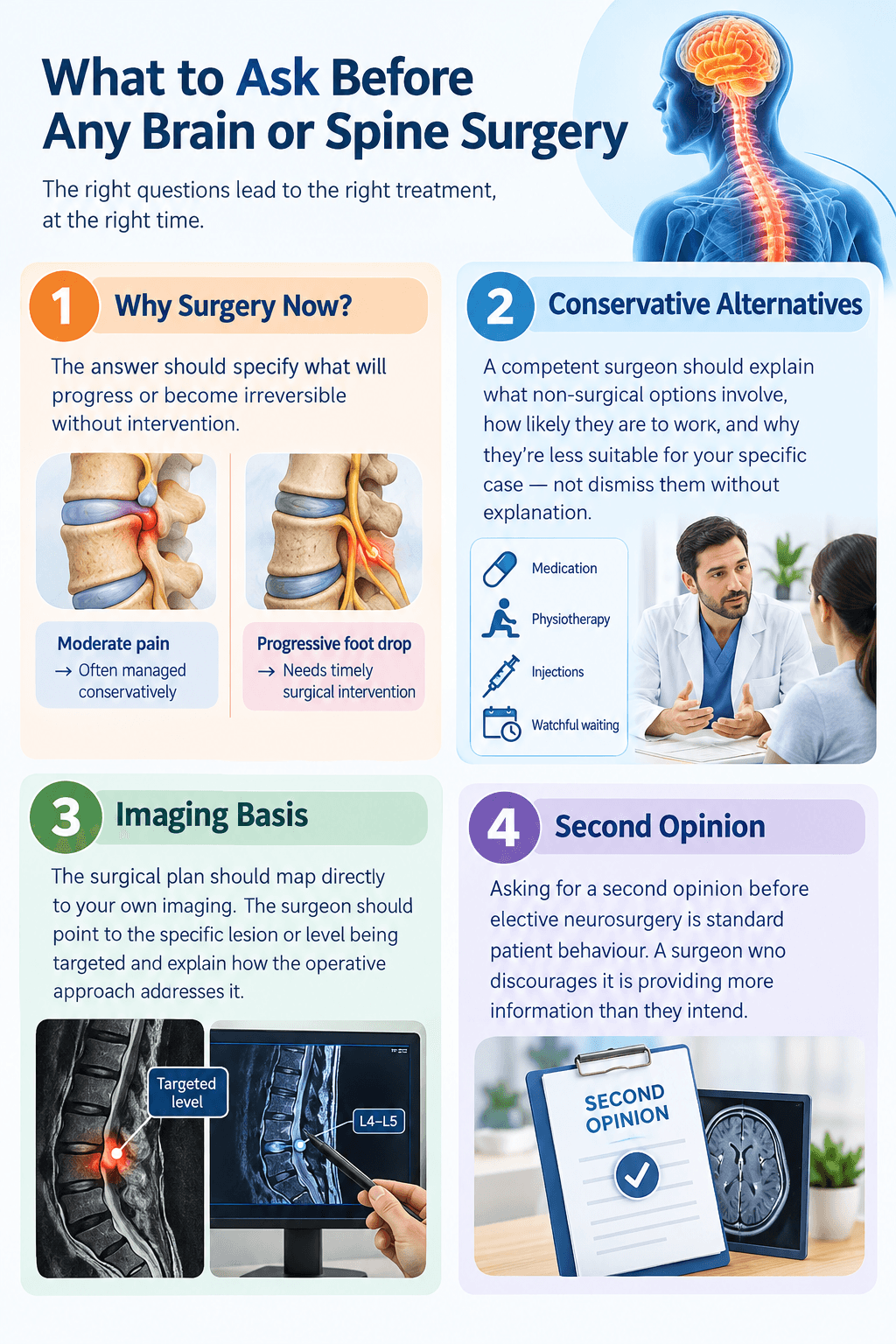
Yes, seeking a second opinion before any elective brain or spine procedure is standard and encouraged.
What should a patient bring to a pre-surgical neurosurgery consultation?
All relevant MRI and CT imaging, current medications, prior surgical records, and a list of specific questions.
Can a patient decline surgery after the consultation?
Yes, informed consent means the patient has the right to decline, defer, or seek further opinion at any point.
How specific should a surgeon's answer be about surgical risks?
Risks should be specific to the patient’s imaging, age, and anatomy not generic population-level statistics.
Disclaimer: The information shared in this content is for educational purposes only and not for promotional use.