

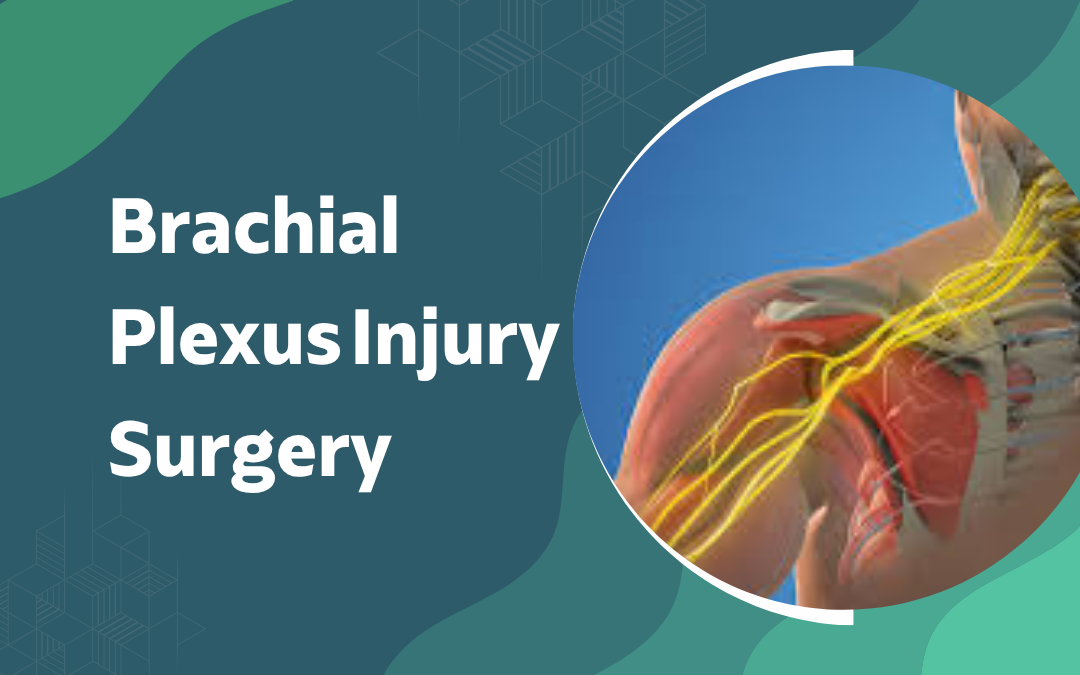
Brachial plexus injuries can often be surgically repaired, though the outcome depends on the type of damage and how quickly treatment begins. A stretch injury may recover without intervention. A rupture can be bridged with a nerve graft. An avulsion, where the root is torn from the spinal cord, cannot be directly reattached but can be addressed through nerve transfer. One principle holds across all of them: earlier surgery produces better results.
According to Dr. Gurneet Singh Sawhney, a leading Neurosurgeon in Mumbai, the nerve doesn’t wait politely, the muscle it feeds starts wasting the moment it loses its supply, and after a year or so there’s often nothing left to reconnect to. That’s why I’d far rather see one of these at three months than at twelve.
Arm weak or limp after an accident?
Can Surgery Actually Fix It?
What’s possible depends entirely on how the nerves were damaged, and that varies hugely.
Stretch: a milder traction injury often recovers on its own, so these get watched for a few months before anyone reaches for a scalpel
Rupture: a nerve torn partway along can usually be repaired, bridging the gap with a graft taken from elsewhere
Avulsion: when the root is torn straight off the spinal cord there’s nothing to stitch back, so a working nerve gets rerouted to do the job instead
Transfers: late or severe cases sometimes call for moving a muscle or tendon to stand in for what won’t recover
And the toolkit is genuinely large, repair, graft, nerve transfer, muscle transfer, each picked to fit the injury. Functional neurosurgery encompasses peripheral nerve reconstruction, and the outcome depends largely on matching the right technique to the right injury at the right time.
Why Does Timing Matter So Much?
The window for repair is real and unforgiving, because a muscle left without its nerve doesn’t wait forever.
The clock: a denervated muscle slowly becomes unusable, and past roughly twelve to eighteen months reconnecting the nerve won’t wake it up
Imaging: scans and an MR myelogram show whether the roots pulled away from the cord, which is where spine surgery level assessment overlaps
Wait and watch: mild closed injuries get a few months to recover on their own before any operation is planned
Early beats late: the same repair done at three months simply outperforms the one done at a year, every time
So delay is the enemy here, far more than severity alone. This guide on spinal cord injuries covers the timing and recovery principles that apply whenever nerves and cord are at risk.
Why Choose Dr. Gurneet Singh Sawhney?
Dr. Gurneet Singh Sawhney trained in microneurosurgery in Japan and has more than 18 years on nerve injury and reconstruction, the kind of work where a few months’ delay changes the whole outcome. Reading the injury early and moving fast is the core of it.
A young patient with a flail arm after a bike crash can, caught in time, get elbow bend and shoulder control back. Not a perfect arm. A working one. The difference usually comes down to how fast they were seen.
Frequently Asked Questions
Can every brachial plexus injury be repaired?
No, mild ones recover alone and very late or severe ones may not.
What is the best time for surgery?
Usually within three to six months, before the muscles become impossible to reinnervate.
What is a nerve transfer?
Rerouting a working nerve to power a muscle whose own nerve can’t recover.
Does surgery fully restore the arm?
Rarely fully, but it can bring back meaningful, useful movement and function.
Disclaimer: The information shared in this content is for educational purposes only and not for promotional use.