

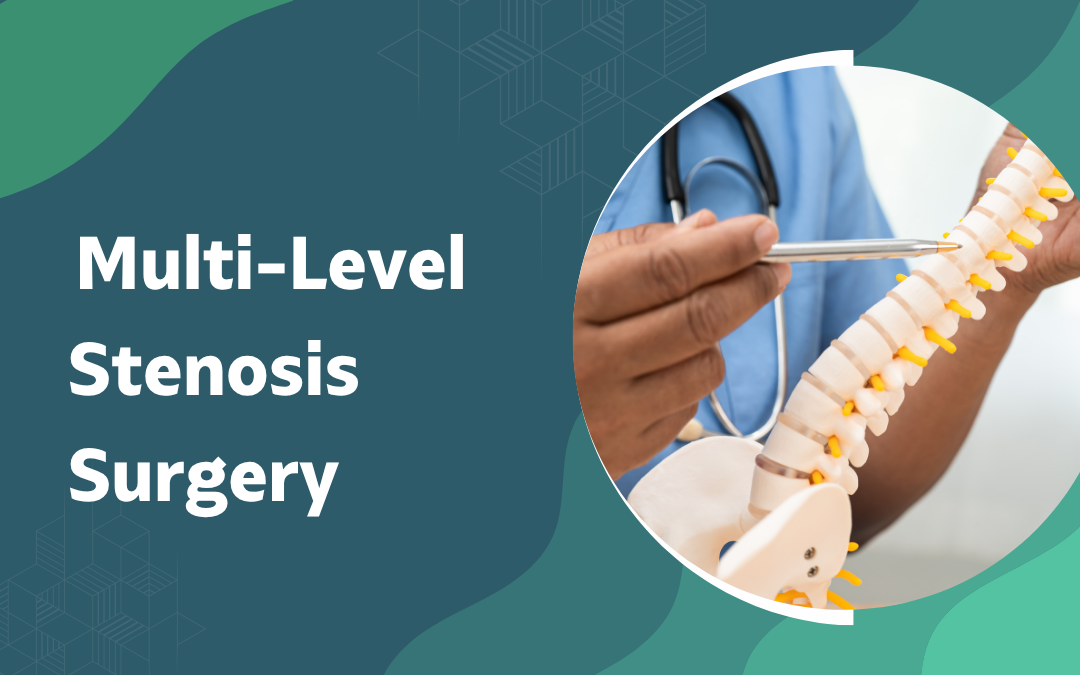
No, fusion is not always needed for multi-level stenosis. Decompression alone, removing the bone or tissue narrowing the canal, is sufficient when the spine remains stable. Fusion becomes necessary when instability is present, such as spondylolisthesis, or when the decompression itself would destabilize the spine. Most multi-level stenosis cases can be assessed clearly on imaging, and the decision comes down to whether the spine holds its alignment once the canal is opened.
According to Dr. Gurneet Singh Sawhney, a leading spine specialist in Mumbai, the question is almost never whether to decompress, it’s whether the spine needs stabilising before or after. Decompression without fusion is a perfectly sound operation for multi-level stenosis when the motion segments are stable.
Multi-level stenosis causing leg pain or weakness that isn’t settling?
When Can Multi-Level Stenosis Be Treated Without Fusion?
Decompression alone works well when the spine is stable and the narrowing is the primary problem.
Stability: a spine with no spondylolisthesis and preserved disc height often handles decompression without fusion, the canal opens and the segment holds its position
Laminectomy: removing the back of the vertebra to relieve canal pressure is frequently sufficient across multiple levels when sagittal and coronal alignment is maintained
Recovery: decompression without fusion carries shorter operating times, less blood loss and a meaningfully faster return to activity than a combined procedure
Outcome: leg pain and neurogenic claudication from stenosis respond well to decompression alone in appropriately selected patients, with benefit reported in around 80 percent of cases
So the decision isn’t reflexive. Adding fusion to every multi-level decompression isn’t evidence-based and it isn’t what most patients need. Spine surgery assessment starts by establishing whether the motion segments are genuinely unstable.
When Does Fusion Become Necessary?
Instability, deformity and the mechanics of the decompression itself all tip the decision toward fusion.
Spondylolisthesis: one vertebra slipping forward on another means the segment is already unstable, and decompressing it without fixing it in place tends to worsen the slip over time
Decompression extent: removing both facet joints to open a severely narrowed canal leaves nothing to stabilise the motion segment, so fusion restores the structural support that the decompression removes
Deformity: significant coronal or sagittal imbalance alongside stenosis usually needs corrective fusion rather than decompression alone, since the deformity drives the symptoms as much as the narrowing does
Persistent pain: when nerve pain doesn’t fully resolve after decompression, spinal cord stimulation is a recognised next step rather than defaulting to further surgery
Even when fusion is needed, limiting it to the unstable levels preserves motion elsewhere and reduces adjacent segment risk. This guide on minimally invasive spine surgery covers how approach choice affects recovery across both decompression and fusion procedures.
Why Choose Dr. Gurneet Singh Sawhney?
Dr. Gurneet Singh Sawhney trained in spine surgery in Japan and has over 18 years managing multi-level degenerative disease across decompression alone and combined fusion procedures. Knowing which procedure the condition actually demands, and stopping there, is where the experience earns its keep..
Patients referred for multi-level stenosis often arrive expecting a large fused construct. Many leave with a plan for decompression alone, a shorter operation and no fused segments to worry about long-term. The distinction between the two is what the assessment is for.
Frequently Asked Questions
Does multi-level spinal stenosis always need surgery?
No, mild stenosis without significant symptoms is often managed conservatively first.
What is the difference between decompression and fusion?
Decompression removes the narrowing; fusion additionally stabilises the motion segment with implants.
How long does recovery take after multi-level fusion?
Fusion recovery typically takes several months longer than decompression alone.
Can stenosis come back after surgery?
Yes, stenosis can recur at adjacent levels over time after any spinal decompression.
Disclaimer: The information shared in this content is for educational purposes only and not for promotional use.