

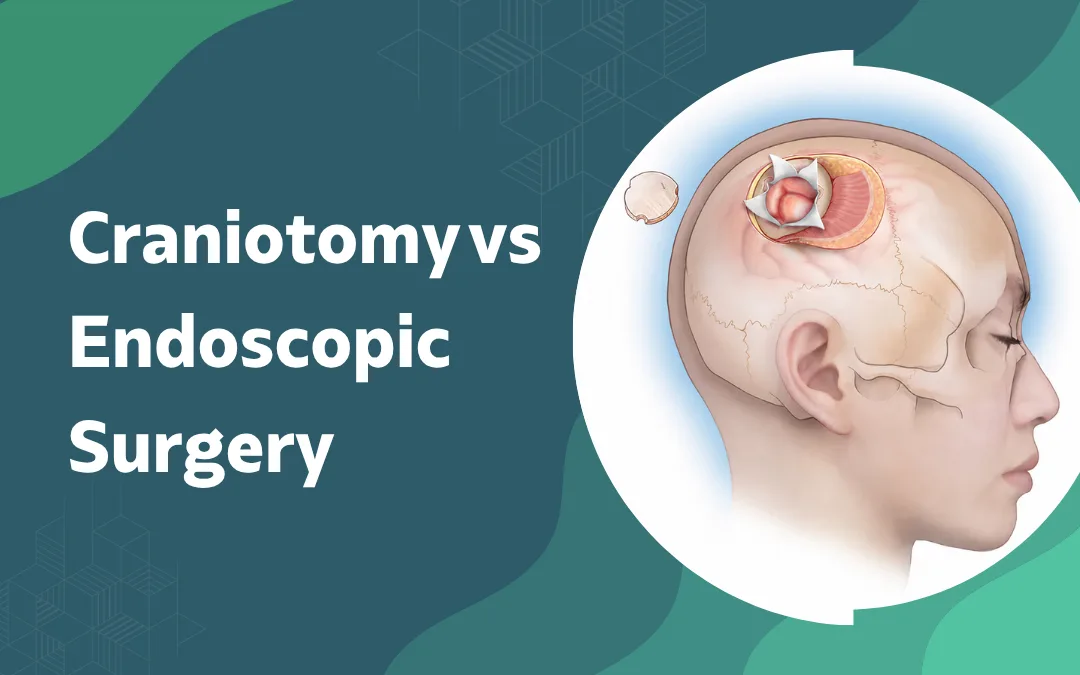
Neither approach is universally safer. The choice depends on the lesion type, its location and whether the pathology can be reached through a minimally invasive route. Craniotomy offers the widest access for complex pathology. Endoscopic surgery reaches certain areas through smaller openings with less disruption to surrounding tissue. Each carries an excellent safety profile when matched to the right case.
According to Dr. Gurneet Singh Sawhney, a leading neurosurgeon in Mumbai, the safer operation is the one matched correctly to the pathology, not the one with the smaller incision. Endoscopic surgery is less invasive, but for a tumour that needs wide access and direct haemostasis, a craniotomy in experienced hands is the safer choice.
Brain surgery recommended and unsure which approach fits your case?
How Do Craniotomy and Endoscopic Surgery Differ?
One opens the skull. The other finds a route through it. That difference shapes everything that follows.
Access: craniotomy removes a portion of the skull to expose the brain directly, while endoscopic surgery passes a thin scope through a small burr hole or natural corridor such as the nasal passage
Visualisation: craniotomy gives the surgeon a wide, direct field and full instrument mobility. Endoscopic surgery offers a camera view through a narrow corridor, with more limited reach.
Brain disruption: endoscopic approaches cause less retraction of surrounding brain tissue, which matters when the lesion can be reached without opening a wide corridor
Recovery: endoscopic surgery typically means a shorter stay and faster return to function. That advantage only holds when the approach is genuinely appropriate for the lesion in question.
The two are not interchangeable alternatives for the same problem. Which one the specific pathology demands is where brain surgery assessment starts.
Which Cases Suit Each Approach?
The pathology decides. Location decides. What the imaging actually shows decides. Patient preference is a factor, never the determining one.
Craniotomy: large or vascular tumours, aneurysm clipping, AVM resection, subdural haematoma and any lesion needing direct haemostasis or wide exposure are consistently better handled through an open approach
Endoscopic: pituitary tumours through the nasal corridor, colloid cysts in the ventricles, hydrocephalus procedures, these are textbook endoscopic cases where the minimally invasive route is now the established standard
Skull base: certain skull base tumours sit in natural corridors where endoscopic access is actually superior to craniotomy, avoiding brain retraction entirely
Combined: complex cases sometimes use both within a single procedure, endoscopic for visualisation, craniotomy for resection, neither used exclusively
Matching the technique to what the imaging shows is what the decision comes down to. This guide on recovery after brain tumor surgery sets realistic expectations for what the post-operative period actually looks like.
Why Choose Dr. Gurneet Singh Sawhney?
Dr. Gurneet Singh Sawhney trained in Japan and has spent over 18 years operating across both craniotomy and endoscopic brain surgery. Open cranial work, endoscopic skull base and ventricular procedures, combined approaches for complex cases. The full range, not just one end of it.
Patients ask which operation is safer. The more useful question is which one is right for what the scan shows. That distinction is what the first consultation is built around.
Frequently Asked Questions
Is endoscopic brain surgery always safer than craniotomy?
No, safety depends on the lesion type and location, not the approach alone.
Which brain tumours are best treated endoscopically?
Pituitary tumours and ventricular lesions such as colloid cysts suit endoscopic approaches well.
Does craniotomy leave a permanent scar?
Yes, but modern techniques keep incisions small and within the hairline.
Can endoscopic surgery and craniotomy be combined?
Yes, complex cases sometimes use both approaches within a single procedure.
Disclaimer: The information shared in this content is for educational purposes only and not for promotional use.