

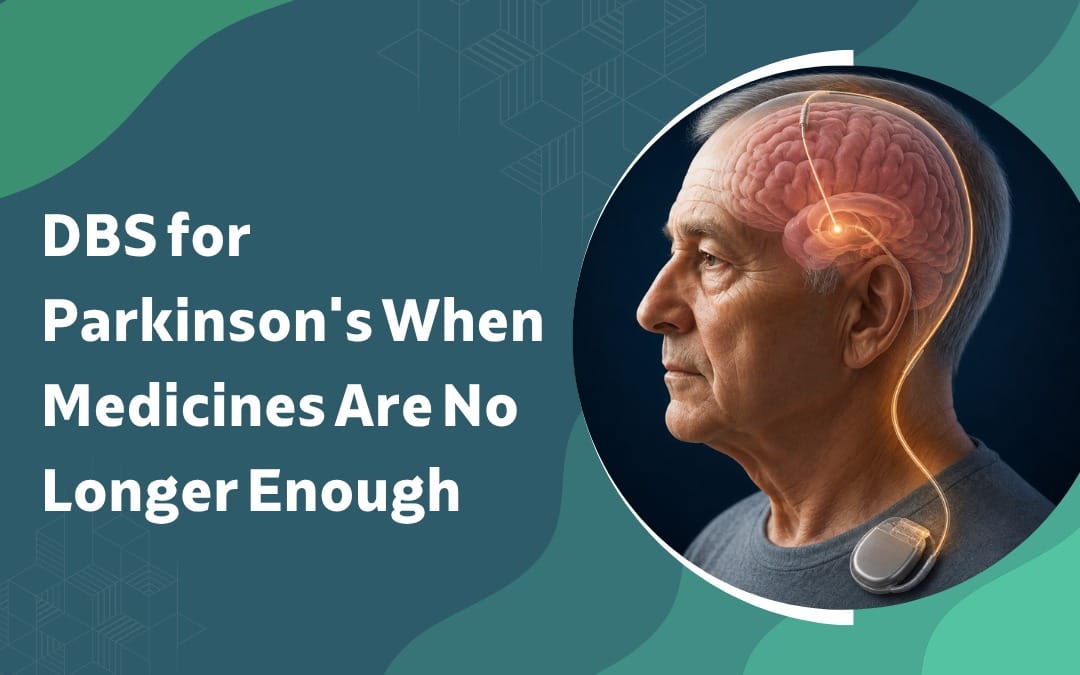
Noticing that your Parkinson’s medications are wearing off faster or causing uncontrolled movements?
How Do You Know When Parkinson’s Medication Is No Longer Working?
Medication failure in Parkinson’s isn’t always sudden. It shows up as a gradual erosion of the hours each dose buys, with specific patterns that signal the disease has outpaced what levodopa can reliably deliver.
Wearing-Off: The medication’s effect shortens to two hours or less per dose, leaving gaps of stiffness, slowness, and tremor between doses that weren’t there in the early years, and adding doses produces diminishing returns rather than consistent relief.
Dyskinesia: Involuntary writhing or jerking movements at peak dose concentration indicate levodopa sensitivity has shifted. The therapeutic window between under-dose and over-dose has narrowed significantly and adjusting doses alone won’t resolve it.
On-Off Fluctuations: Unpredictable swings between mobile and frozen states that don’t track reliably with dose timing represent one of the most disabling aspects of advanced Parkinson’s, and no medication adjustment fully resolves them once established.
Freezing of Gait: Sudden inability to initiate steps, particularly in doorways or crowded spaces, that doesn’t respond to levodopa increase points to a symptom category where DBS has demonstrated consistent benefit over continued medical management.
Medication adjustments buy time. But there’s a point where the adjustment itself becomes the problem.
Parkinson’s Surgery for movement disorders follows a structured candidacy evaluation before any surgical recommendation is made.
Who Is the Right Candidate for DBS in Parkinson’s Disease?
Not every Parkinson’s patient is a DBS candidate. The selection criteria are specific, and meeting them matters as much as the surgery itself.
Confirmed Parkinson’s Diagnosis: DBS works for idiopathic Parkinson’s disease, not Parkinson’s-plus syndromes like MSA or PSP. Patients who responded well to levodopa historically are the ones who respond well to DBS, as the surgery amplifies levodopa responsiveness rather than replacing it.
Adequate Levodopa Response: A patient who never responded meaningfully to levodopa is unlikely to benefit from DBS, as prior levodopa response is the single most predictive factor for surgical outcome according to a best neurosurgeon in India experienced in movement disorder surgery.
Cognitive Status: Significant cognitive impairment is a relative contraindication for DBS. The programming process requires patient cooperation, and neuropsychiatric side effects are higher in cognitively compromised patients.
Disease Duration and Age: Most guidelines recommend considering DBS after four to five years with established motor fluctuations. Age alone isn’t a cutoff, but patients over 70 with comorbidities face higher surgical risk that must be weighed against expected functional gain.
The right candidate gains three to five additional years of functional independence on average. The wrong candidate carries the surgical risk regardless.
DBS surgery vs Levodopa for Parkinson’s Disease breaks down exactly how the two treatment approaches differ and when surgery becomes the better option.
What to Expect From DBS Surgery for Parkinson’s
DBS isn’t a single procedure. It’s a process that begins before the operation and continues for months after.
Pre-Surgical Evaluation: The workup includes a levodopa challenge test, neuropsychological assessment, MRI brain, and multidisciplinary team review covering neurosurgery, neurology, and neuropsychiatry. This phase takes two to four weeks and determines candidacy and the appropriate brain target.
The Surgery: Electrode leads are placed into the subthalamic nucleus or globus pallidus internus under local anaesthesia, with the patient awake during targeting to allow real-time neurological feedback. A pulse generator is implanted under the collarbone in the same or a subsequent session.
Programming: The stimulator isn’t switched on immediately. Programming begins three to four weeks post-operatively and involves multiple sessions to find optimal settings, adjusting voltage, frequency, and pulse width to maximise motor benefit while minimising side effects.
Long-Term Management: DBS doesn’t eliminate medication. Most patients reduce their levodopa dose significantly but don’t stop entirely, and battery replacement is required every three to five years depending on stimulation parameters and device type.
Results aren’t immediate and programming takes patience. But functional gains in well-selected patients are consistent and durable over five to ten years.
Can DBS Surgery Stop Parkinson’s Tremors? covers what DBS specifically achieves for tremor-dominant Parkinson’s and what it doesn’t.
Frequently Asked Questions
Can DBS cure Parkinson's disease permanently?
No, DBS manages symptoms effectively but does not stop disease progression.
How long does DBS surgery take to show results?
Motor improvements appear within weeks but full benefit emerges over three to six months of programming.
Is DBS surgery safe for elderly Parkinson's patients?
Safety depends on cognitive status and comorbidities, not age alone, evaluation determines eligibility.
Can Parkinson's medication be stopped after DBS?
No, most patients reduce dosage significantly but continue some level of medication post-surgery.
Disclaimer: The information shared in this content is for educational purposes only and not for promotional use.