

Experiencing tremors, focal seizures, or a recently diagnosed brain lesion?
How Does the Stereotactic System Guide Surgical Instruments
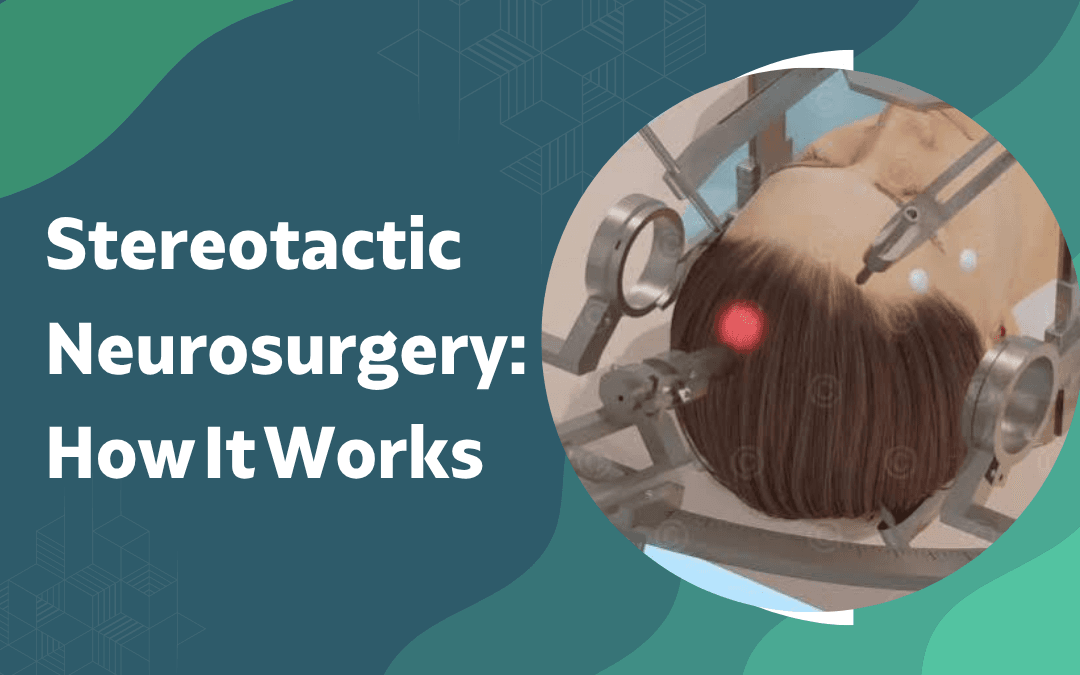
The guidance system combines imaging, software, and a fixed reference frame to create an accurate three-dimensional surgical path before the first instrument enters the brain.
- Frame fixation: A rigid stereotactic frame is bolted to the skull under local anaesthesia, establishing a fixed external coordinate system that doesn’t shift during the procedure, so every spatial calculation stays anchored to one reference point throughout the entire operation.
- Image fusion: MRI, CT, and sometimes PET scans are merged in planning software to give the surgeon a composite map where the target structure, surrounding vessels, and critical cortex are all visible at once within the same spatial grid.
- Trajectory planning: The surgeon plots an entry point and approach angle that avoids blood vessels and eloquent cortex, calculating the exact arc and depth before any instrument is introduced so the electrode or probe follows a pre-confirmed safe corridor.
- Real-time confirmation: Intraoperative microelectrode recording or fluoroscopy verifies that the instrument has reached the intended target, and adjustments can be made within the same coordinate system without repositioning the patient.
Frameless neuronavigation systems using scalp fiducials and robotic arms now offer the same accuracy without a rigid frame, broadening eligibility for patients who aren’t suited to frame-based brain surgery procedures.
What Conditions Are Treated With Stereotactic Neurosurgery?
Stereotactic techniques apply across a range of neurological conditions where precise, deep-brain access is needed and open surgery carries disproportionate risk.
- Movement disorders: Deep brain stimulation for Parkinson’s disease, essential tremor, and dystonia relies entirely on stereotactic guidance to place electrodes in the subthalamic nucleus or globus pallidus with the accuracy those targets demand, given they’re structures only a few millimetres across.
- Brain tumours: Stereotactic biopsy provides tissue diagnosis from deep or eloquent-region tumours where open resection isn’t feasible, and functional neurosurgery planning software determines whether radiosurgery or microsurgical removal is the safer path.
- Epilepsy: Stereo-EEG, the stereotactic implantation of depth electrodes across multiple lobes, maps seizure networks in drug-resistant epilepsy so surgeons can define the resection zone or ablation target with evidence rather than estimation.
- Radiosurgery: Focused radiation platforms like Gamma Knife and CyberKnife use stereotactic coordinates to converge hundreds of low-dose beams on a single intracranial target, destroying tissue at the focal point without exposing the path to a clinically meaningful dose.
Stereotactic procedures have significantly lower rates of surgical site infection and blood loss compared to open craniotomy for equivalent deep-brain targets.What Are the Outcomes of Functional Neurosurgery for Movement Disorders?
Why Choose Dr. Gurneet Singh Sawhney?
Dr. Gurneet Singh Sawhney holds MBBS, MS (General Surgery), and MCh (Neurosurgery) qualifications, stood first in the MCh university examination, and completed fellowships in Functional Neurosurgery and Epilepsy Surgery in Japan. With 18 years of overall experience and 6 years as a specialist, he’s performed hundreds of stereotactic procedures including DBS, lesioning, stereo-EEG, and stereotactic biopsy. He is a member of the Indian Society of Stereotaxy and Functional Neurosurgery (ISSFN).
His patients with movement disorders treated through stereotactic DBS consistently report reduced tremor, lower medication dependence, and return to daily function. That’s the outcome measure that matters, not operative metrics.
Frequently Asked Questions
Is stereotactic neurosurgery the same as radiosurgery?
No, radiosurgery is one application; stereotactic surgery also includes DBS, biopsy, and ablation.
Is a frame always required for stereotactic procedures?
No, frameless neuronavigation systems using scalp fiducials now replace rigid frames in many cases.
How long does a stereotactic procedure take?
Duration ranges from one to six hours depending on target complexity and whether awake mapping is needed.
Is stereotactic surgery painful?
Frame placement uses local anaesthesia; the intracranial procedure itself involves no pain sensation in brain tissue.
Disclaimer: The information shared in this content is for educational purposes only and not for promotional use.