

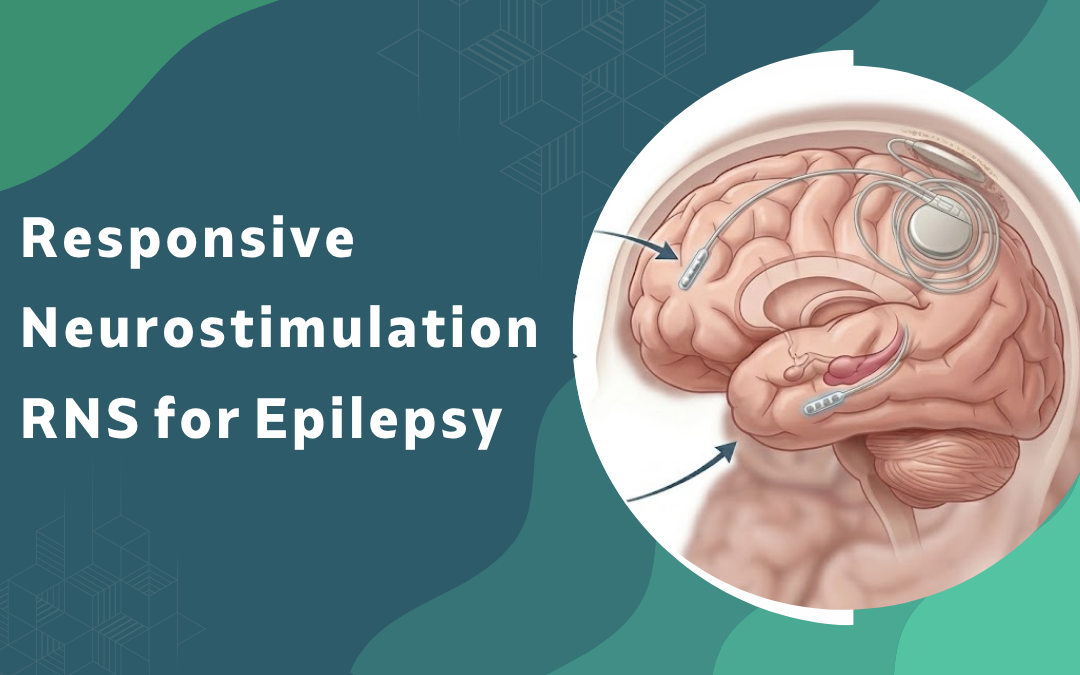
Responsive Neurostimulation (RNS) is an FDA-approved, implantable, closed-loop device that treats drug-resistant epilepsy by continuously monitoring brain activity and delivering targeted electrical stimulation to stop seizures before they spread. It serves patients with focal-onset seizures who aren’t candidates for standard resective surgery. While widely established in the United States, RNS is available at specialized, top-tier epilepsy centres in India as a sophisticated treatment option, though access remains limited to a small number of tertiary neurosurgical units. The device sits inside the skull, connects to depth or strip electrodes placed at the seizure source, and adapts its response over time.
According to Dr. Gurneet Singh Sawhney, a leading authority in epilepsy surgery in Mumbai, RNS doesn’t replace resective surgery. It exists for the patients we couldn’t operate on safely, and that’s a meaningful gap to fill.
Worried your seizures aren’t responding to medication after years of trying?
How Does Responsive Neurostimulation Actually Work?
RNS reads the brain’s electrical signals from the seizure source and intervenes within milliseconds when a seizure pattern begins forming. The system has two parts. A neurostimulator is housed in the skull, and electrodes are positioned exactly where seizures originate.
- Detection: The device samples brainwaves continuously through implanted electrodes and recognises each patient’s unique pre-seizure signature after a learning period.
- Response: Once an abnormal pattern is flagged, brief electrical pulses fire back into the same tissue to disrupt the building seizure before symptoms appear.
- Recording: Every event gets logged. Neurologists download the data wirelessly and adjust stimulation settings without re-opening the skull.
- Adaptation: Settings get refined over months. And that’s why outcomes typically improve gradually rather than overnight.
It’s a learning system, not a fixed one. Patients selected for RNS usually have one or two clearly mapped seizure foci and have failed at least two anti-seizure medications. For those candidates, seizure treatment options now extend well beyond drugs alone.
Is RNS Available in India and What Are the Alternatives?
RNS is available at a small number of specialized epilepsy centres in India, but it remains far from routine because the device hasn’t received broad regulatory clearance and import-cost barriers stay steep. Most Indian patients with drug-resistant epilepsy are evaluated for established surgical options first. Here’s how the choices compare:
Treatment | Mechanism | Indian Availability |
Resective surgery | Removes seizure focus | Widely performed |
Vagus nerve stimulation | Stimulates vagus nerve cyclically | Available, established |
Open-loop thalamic stimulation | Available at select centres | |
RNS | Closed-loop focal stimulation | Top-tier centres only |
So most Indian patients still benefit from resection, VNS, or DBS pathways before RNS becomes a discussion. For an idea of how surgical decisions get made when medication fails, the case of DBS surgery vs Levodopa for Parkinson’s disease walks through similar device-versus-drug reasoning that applies broadly in functional neurosurgery.
Why Choose Dr. Gurneet Singh Sawhney?
Dr. Gurneet Singh Sawhney holds Fellowships in Functional Neurosurgery and Epilepsy Surgery from Japan, with over 18 years of clinical experience. His training under Prof. Sugano at Juntendo University covered the exact decision-making framework that separates RNS candidates from resection candidates from VNS candidates, which makes a Dr. Gurneet Singh Sawhney consultation valuable for second opinions on drug-resistant epilepsy.
Most patients walking in with refractory seizures haven’t been told all their options exist. They get told one. We explain four, then pick the right one for that brain.
FAQ's
Who qualifies for RNS therapy?
Adults with focal drug-resistant epilepsy and one or two identifiable seizure sources qualify.
Does RNS cure epilepsy completely?
No, RNS reduces seizure frequency significantly but rarely eliminates seizures entirely.
How long does the RNS battery last?
Battery life ranges from 8 to 11 years depending on stimulation settings.
Is RNS surgery reversible?
Yes, the device can be removed if outcomes are poor or complications develop.