

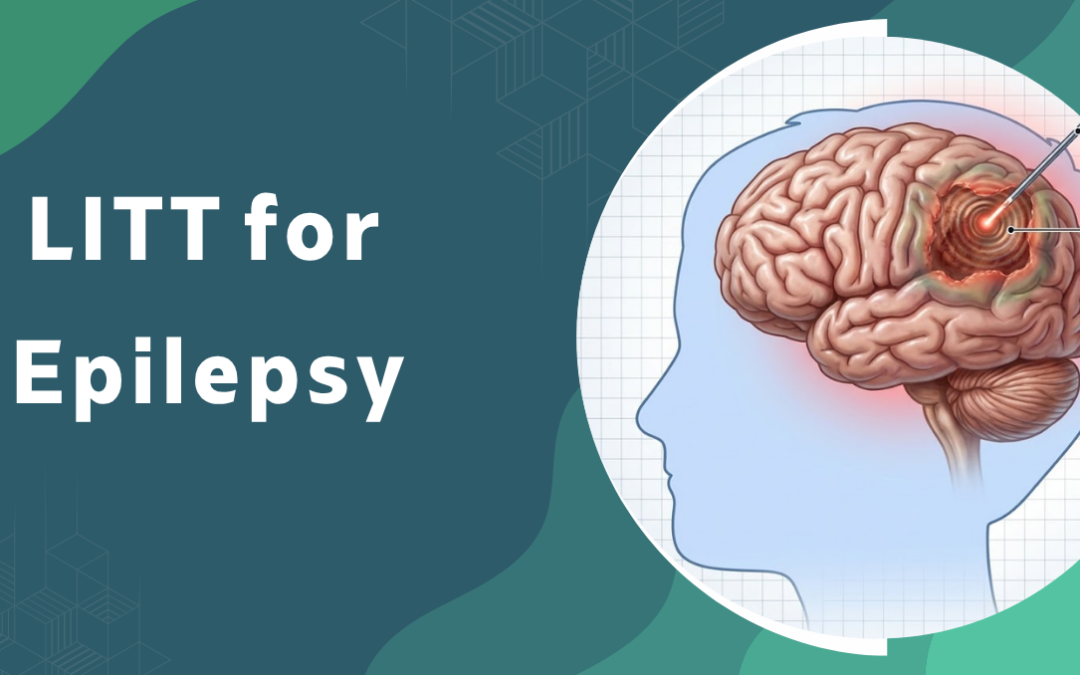
Laser interstitial thermal therapy, or LITT, is a minimally invasive MRI-guided procedure that uses heat to destroy the brain area causing seizures in people whose epilepsy hasn’t responded to medication. Instead of opening the skull the way a craniotomy does, the surgeon works through a 3mm hole in the scalp. A thin laser fibre goes in. It’s steered to the seizure focus using stereotactic navigation, and the actual ablation happens inside an MRI scanner so the surgeon can watch the temperature climb in real time and stop the moment the target is treated. Hospital stay is short. One night, sometimes two. Most patients are walking around within a week and back to normal life inside two.
According to Dr. Gurneet Singh Sawhney, a pioneer in epilepsy surgery in Mumbai, LITT lets us reach seizure foci that were once considered too risky to open, and the live MRI thermometry means we stop the moment the target is treated.
Still having seizures despite trying multiple medicines?
Who Qualifies for LITT and How Does the Procedure Work?
LITT isn’t an option for everyone with epilepsy. The candidacy criteria are tight, and skipping any of them is how surgery goes wrong.
- The patient has tried at least two antiseizure medicines at proper doses without getting seizure control. Roughly one in three epilepsy patients fall into this category.
- The seizures come from one specific spot in the brain, and that spot has been pinpointed during workup. Video-EEG plus high-resolution MRI does most of the mapping. PET or SEEG gets added if the picture isn’t clear enough.
- The day itself runs under general anesthesia. A small drill hole, the laser fibre threaded to target, then ablation inside the MRI with thermal mapping running live on screen.
- Discharge usually happens within 24 to 48 hours. There’s no big incision to recover from, so people get back on their feet quickly.
For complicated cases, the surgical team usually does the candidacy work alongside seizure treatment planning so the focus is mapped properly before any laser fires.
How Does LITT Compare to Open Epilepsy Surgery?
Seizure freedom is the goal in both cases. How you get there looks completely different though, and the trade-offs matter when you’re picking one. Easier to read it side by side.
Factor | LITT | Open Resection |
Incision | 3 mm hole | Large craniotomy |
Anesthesia time | 3 to 4 hours | 5 to 8 hours |
Hospital stay | 1 to 2 days | 4 to 7 days |
Recovery | 1 to 2 weeks | 4 to 6 weeks |
Seizure freedom | 55 to 65% | 65 to 75% |
Memory preservation | Significantly better | Higher deficit risk |
Best fit | Deep, small focus | Larger surface lesions |
Open resection still has a slight edge on raw seizure-freedom rates for some anatomies. The data backs that up. Where LITT pulls ahead is on cognitive preservation and recovery time, particularly when the lesion is small and sits deep where opening would mean cutting through too much healthy tissue. Some patients also look at DBS surgery when the focus can’t be safely ablated, since neuromodulation works on a completely different principle.
For more on candidacy frameworks and how seizures get evaluated before surgery, see the Epilepsy Surgery overview blog.
Why Choose Dr. Gurneet Singh Sawhney?
Dr. Gurneet Singh Sawhney holds an MCh in Neurosurgery, a Fellowship in Epilepsy Surgery from Juntendo University, Japan, and a Fellowship in Functional Neurosurgery from Tokyo Women’s Medical University. He’s been working in stereotactic and minimally invasive neurosurgery for over 18 years, which is exactly the case profile LITT was built for.
Patients who consult him for drug-resistant epilepsy go through a full pre-surgical workup before anything is recommended. The decision is based on what the imaging and EEG actually show, not on what’s procedurally easiest.
FAQ's
Is LITT a permanent cure for epilepsy?
LITT can produce long-term seizure freedom in 55 to 65% of well-selected focal epilepsy patients.
How long does the LITT procedure take?
The full procedure including imaging and ablation typically takes 3 to 4 hours under general anesthesia.
Will I need to stop seizure medicines after LITT?
Most patients stay on medication for 1 to 2 years before any tapering is considered.
Can LITT be repeated if seizures return?
Yes, LITT can be repeated or followed by other epilepsy procedures if seizures recur.