

Freezing of gait is a sudden, brief inability to initiate or continue walking; feet feel fixed to the floor, and steps won’t start or stop abruptly mid-stride. It lasts seconds to minutes and happens most at doorways, turns, and narrow spaces. It’s unpredictable and one of the most fall-prone moments in Parkinson’s disease. It’s also one of the hardest symptoms to treat it doesn’t respond to levodopa the way tremor and rigidity do, and DBS doesn’t reliably fix it either. Around 50% of Parkinson’s patients develop it. Most don’t know what it is until they’re already on the floor.
According to Dr. Gurneet Singh Sawhney, a neurosurgeon in mumbai, Parkinson’s surgery, “Freezing of gait is the symptom families call me about the most urgently it’s not the tremor that lands a patient in hospital, it’s freezing mid-step at the top of the stairs.”
Sudden episodes of being unable to move feet during walking in doorways, turns, or crowds?
What Causes Freezing of Gait in Parkinson's Disease?
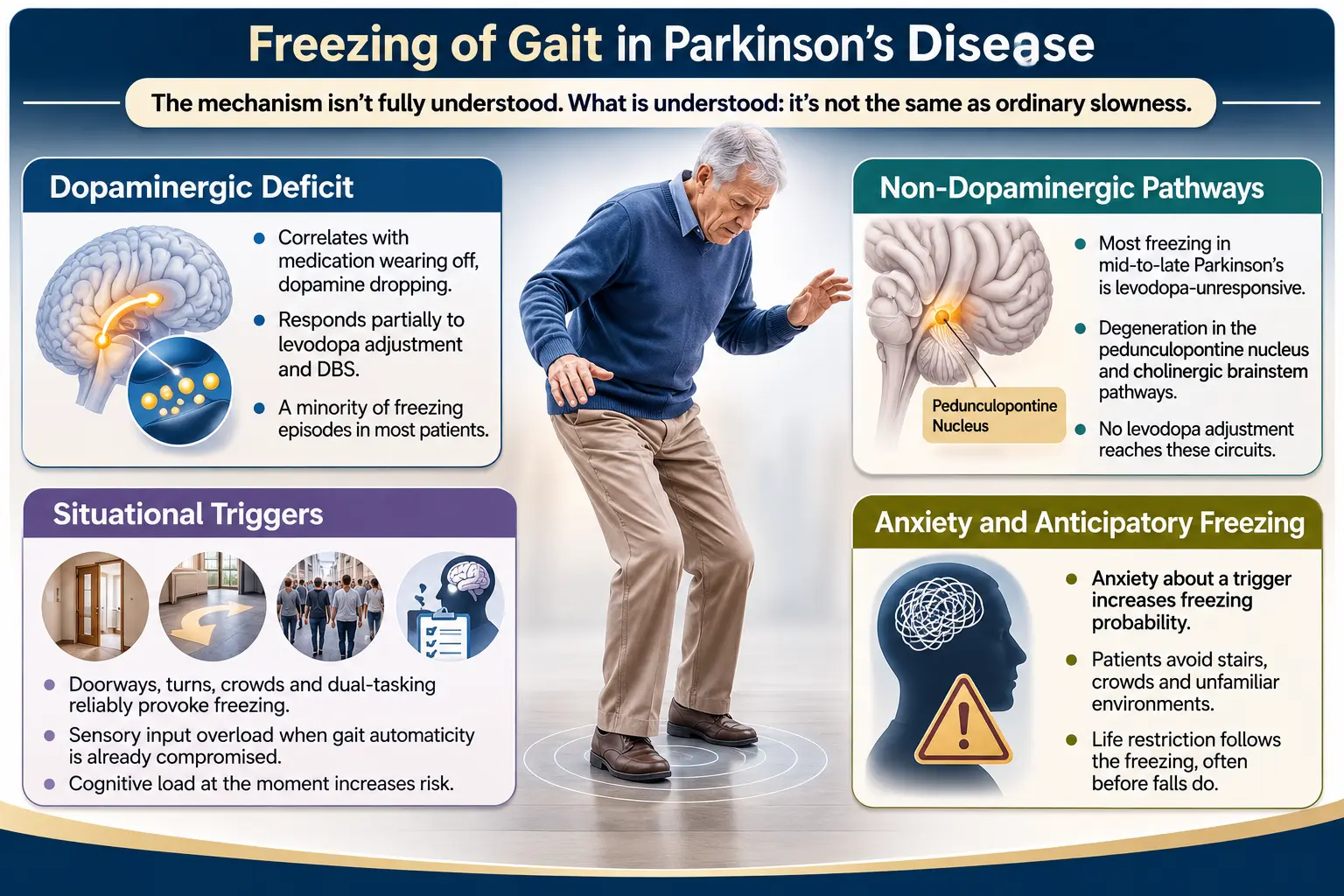
Freezing early in Parkinson’s or as the dominant symptom at onset should prompt reassessment for atypical Parkinsonism, particularly PSP. The differential workup runs through Parkinson’s surgery movement disorder assessment.
What Helps Freezing of Gait in Parkinson's Disease?
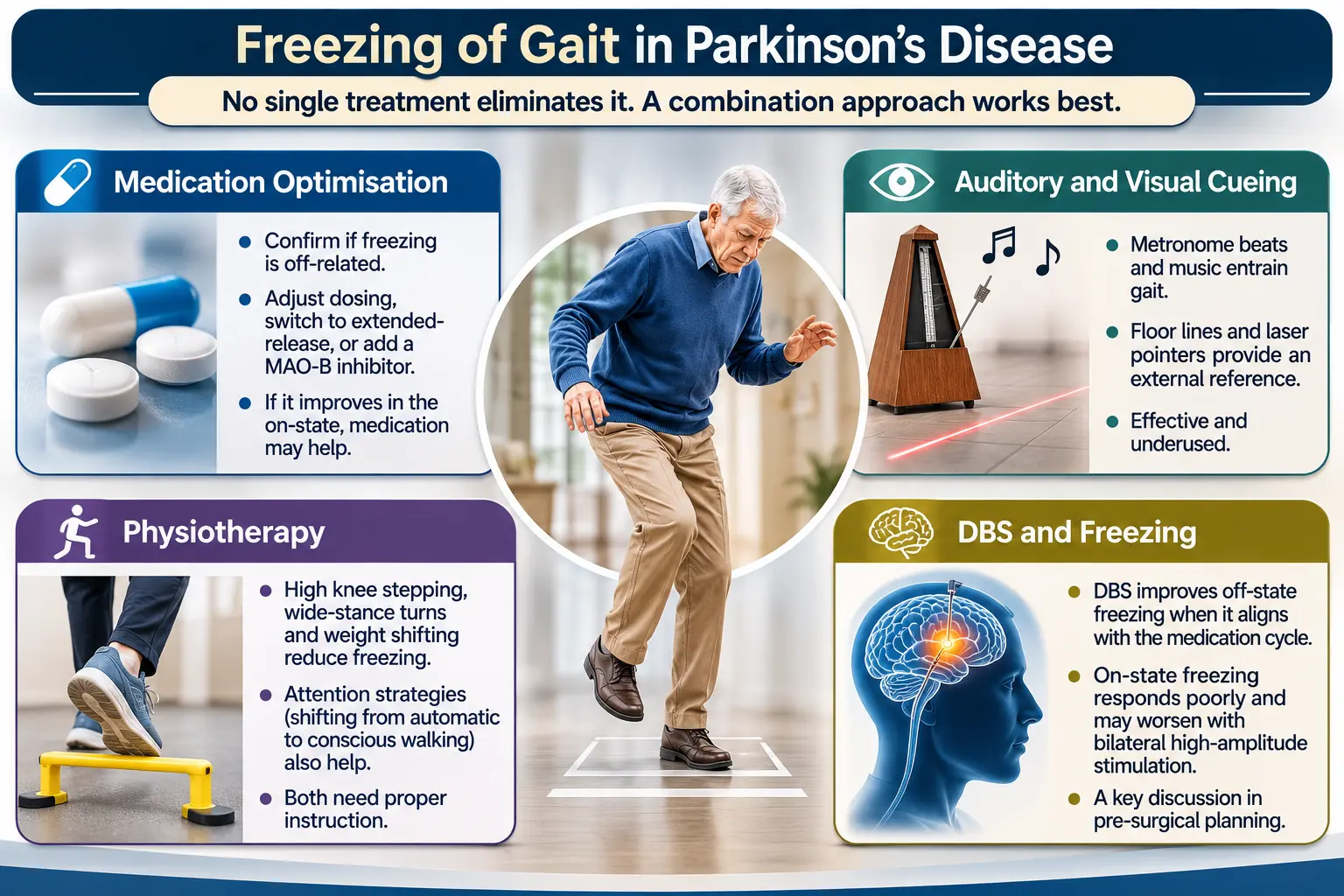
For structured balance and stepping exercises addressing fall risk alongside freezing, see Parkinson’s balance exercises.
What Does CSF Analysis Actually Show?
Freezing kills through falls. The safety risk is the clinical priority.
- Fall mechanism: The freeze itself is brief. The recovery attempt shuffling, rocking, lurching forward is when the fall happens. Hip fractures, head injuries, and subdural haematomas follow. Most are preventable with environmental modification and gait strategy.
- Home environment: Tape lines at doorways. Remove rugs, threshold steps, and narrow passages. Grab rails at turning points. Specific, evidence-based modifications not generic fall prevention advice.
- Assistive devices: Standard walking frames worsen freezing. U-step walkers with built-in laser lines and rhythm cues are designed specifically for Parkinson’s freezing. Rollators with auditory feedback reduce episodes in community studies.
- Carer education: Pulling or pushing a patient through a freeze increases fall risk. The correct response is to pause, cue with sound or a visual target, and let the patient initiate the step. Not intuitive; requires specific instruction most families never receive.
For the broader context of when freezing signals that medication has reached its limit and surgical options need discussion, see when Parkinson’s medicines are no longer enough.
Frequently Asked Questions
Is freezing of gait the same as bradykinesia in Parkinson's?
No. Bradykinesia is general slowness of movement. Freezing is a sudden episodic inability to move the feet, unrelated to overall speed.
Does levodopa fix freezing of gait in Parkinson's?
Only for off-state freezing that correlates with medication wearing off. Levodopa-unresponsive freezing, the more common type in advanced disease, doesn’t improve with dose adjustment.
What is the fastest way to unfreeze during a freezing episode?
Auditory cueing counting, music, a metronome or visual cueing a line on the floor, a laser pointer can interrupt a freeze faster than any medication.
Can DBS surgery help with freezing of gait?
Variable. Off-state freezing often improves. On-state freezing that’s already present during the best medication window is unlikely to respond to DBS and may worsen.
References
Disclaimer: The information shared in this content is for educational purposes only and not for promotional use.