

Occupational therapy after stroke retrains the skills needed for daily life dressing, eating, bathing, writing, and hand use by rebuilding movement and cognition and adapting tasks to what the patient can currently do. Progress is measured in tasks managed independently, not exercise scores. Therapy starts in hospital within days of stabilisation and continues at home. Memory, attention, vision, and judgment are part of the work alongside physical function. Every plan is built around what the patient needs to return to.
According to Dr. Gurneet Singh Sawhney, neurosurgeon in Mumbai, “Patients often ask when the arm will recover, but the better question is which daily tasks they want back first, because that’s what occupational therapy is built around.”
Is a stroke making simple tasks like dressing or holding a cup difficult?
What Does Occupational Therapy Address After Stroke?
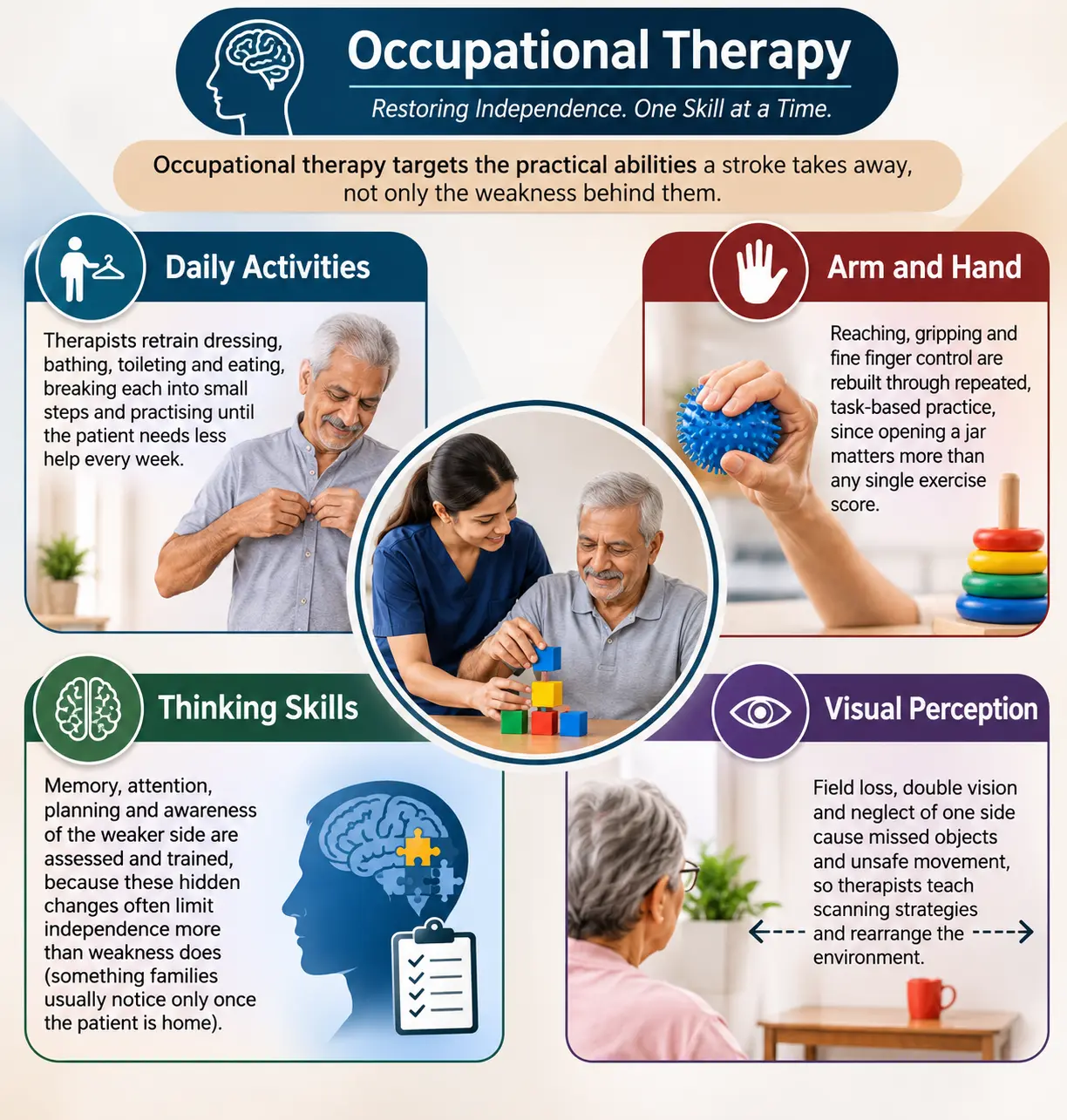
Occupational therapy works alongside speech and swallowing therapy and physiotherapy as part of one rehabilitation team.
How Does Occupational Therapy Support Stroke Recovery?
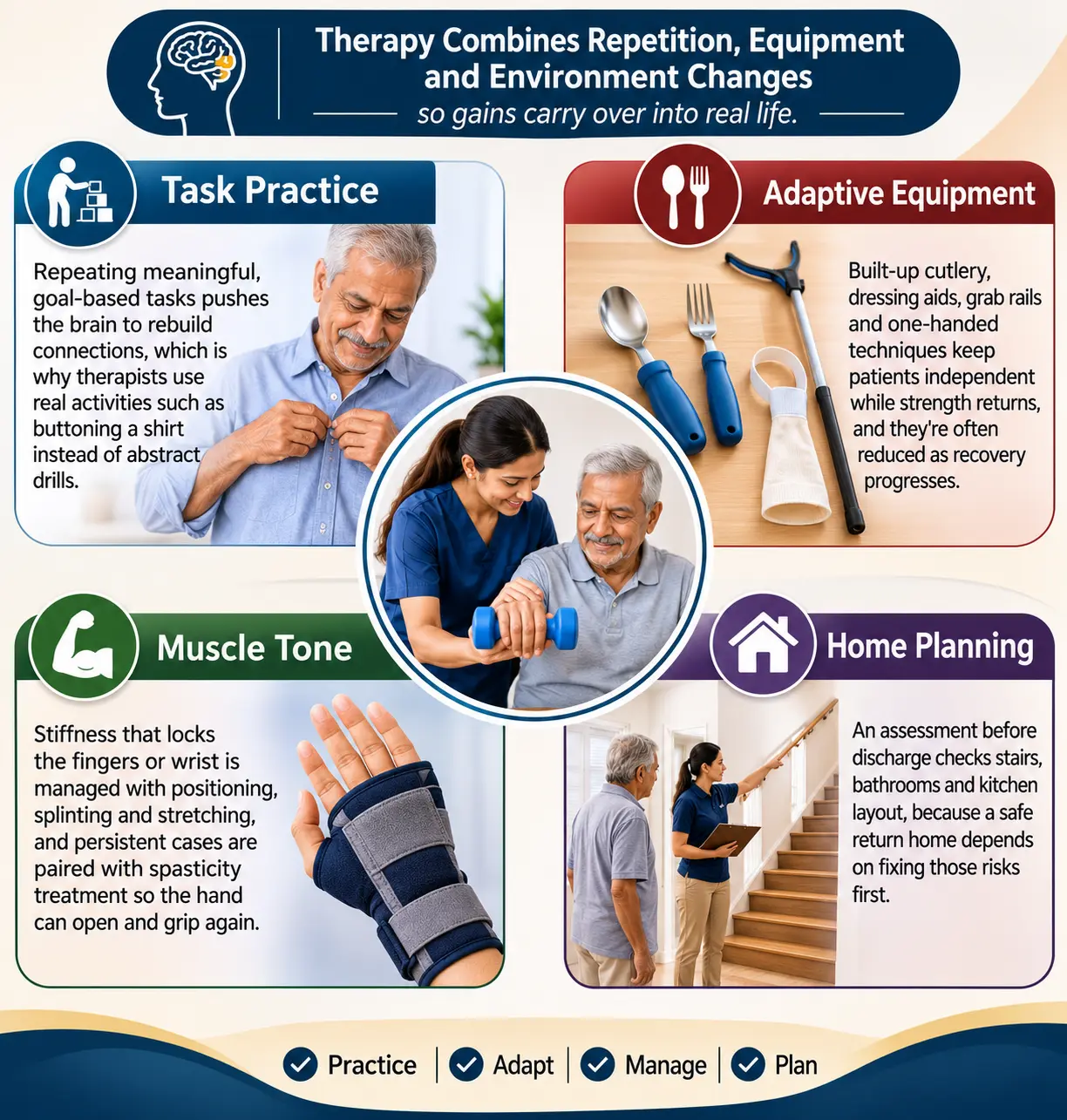
Most recovery happens in the first few months. Early, repeated and practical practice makes the difference. Stiffness after stroke is covered in more detail in how to treat spasticity after stroke.
What Determines the Right Treatment Approach?
Therapy plans are built from a detailed assessment, not from the stroke diagnosis alone.
- Stroke Location: a stroke on one side of the brain affects the opposite side of the body, and its location decides whether weakness, language trouble or spatial neglect leads the plan.
- Severity: mild hand weakness may point toward fine skills and return to work, while major weakness starts with transfers, sitting balance and basic self-care.
- Time Since Stroke: early therapy centres on safety and preventing complications, and later phases move toward independence, though gains can continue well beyond the first few months.
- Personal Goals: job, family role and hobbies decide which activities get practised first, so a cook, a driver and a student end up with different programs.
Assessment findings, not the stroke label alone, set the starting point and the pace of spasticity treatment.
Frequently Asked Questions
When should occupational therapy start after a stroke?
Usually within days, once the patient is medically stable.
Can occupational therapy help a weak arm recover?
Yes, repeated task practice improves arm and hand use in many patients.
Is occupational therapy the same as physiotherapy?
No, physiotherapy targets movement while occupational therapy targets independence in daily tasks.
How long does occupational therapy continue after stroke?
Often for months, depending on progress and the patient’s goals.
References
- National Center for Biotechnology Information (NCBI): Effect of Occupational Therapy on Upper Limb Function and Related Outcomes After Stroke, a Systematic Review and Meta-Analysis
- National Center for Biotechnology Information (NCBI): Interventions Within the Scope of Occupational Therapy in the Post-Stroke Hospital Discharge Process, a Systematic Review
Disclaimer: The information shared in this content is for educational purposes only and not for promotional use.