

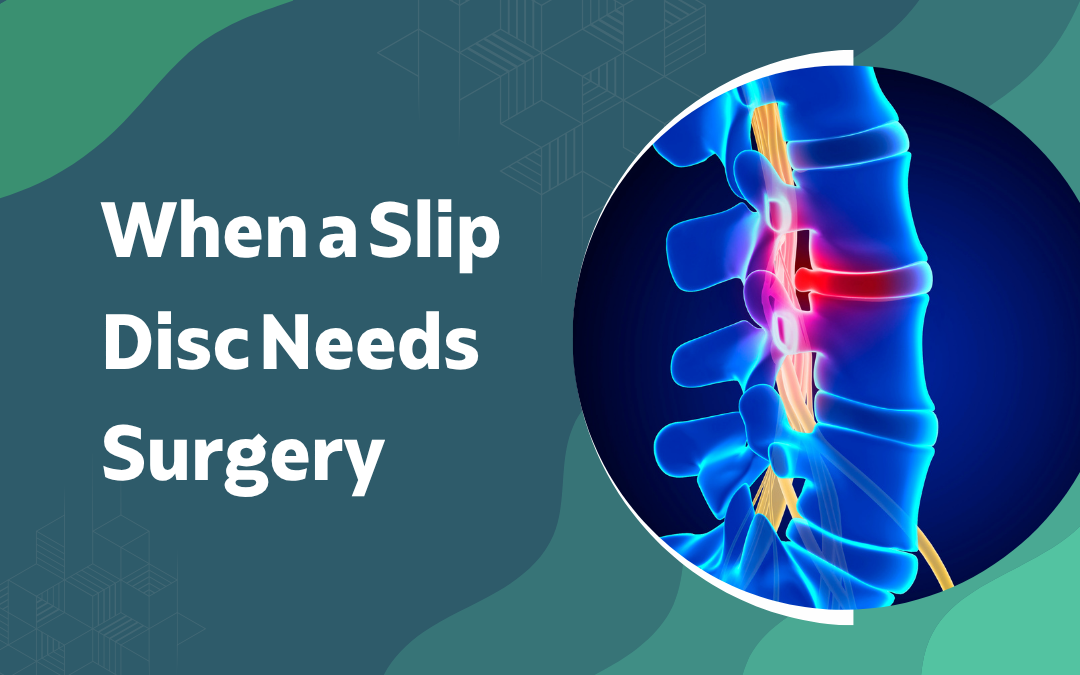
For most people, conservative treatment is right. The large majority of slipped discs settle with physiotherapy, medication and a bit of patience, no operation needed. Surgery is the right call when the nerve’s in danger, real weakness, a foot that’s dropping, or pain that won’t ease after weeks of proper care. And cauda equina, losing bladder control, is an emergency that skips the queue. So conservative first, almost always. Surgery when the disc forces the issue.
According to Dr. Gurneet Singh Sawhney, a leading spine specialist in Mumbai, most slipped discs quietly reabsorb over weeks, so operating early often fixes a scan that was going to settle anyway. The judgement is spotting the few that won’t, weakness that’s deepening or pain that’s stopped responding, before they cost the patient real function.
Disc pain refusing to ease for weeks?
Which Slip Disc Treatment Fits Your Case?
The right route depends on how the nerve is doing and how the pain behaves.
Factor | Conservative Treatment | Surgery |
Best for | most discs, mild to moderate pain, no nerve danger | severe or progressive weakness, red flags, stuck pain |
What it involves | physiotherapy, medication, time, sometimes injections | microdiscectomy to lift the disc off the nerve |
Recovery | gradual over weeks as the disc resorbs | fast leg-pain relief, short recovery if minimally invasive |
Risk | very low, mainly slow progress | small surgical risks, as with any operation |
Timeline | first-line for six to twelve weeks | considered after that, or sooner with red flags |
For ordinary discs, waiting beats rushing, the one-year result barely differs. That’s why measured spine surgery practice tries conservative care first.
When Does a Slip Disc Actually Need Surgery?
Surgery moves to the front when the nerve is being harmed or the pain simply won’t let go.
Emergency: sudden bladder or bowel trouble with saddle numbness is cauda equina, and that one gets operated on within hours
Weakness: a dropping foot or power that keeps fading means the nerve’s under real threat, not just irritated
Stuck pain: pain still severe after six to twelve weeks of honest conservative care is a fair trigger to operate
After surgery: if nerve pain hangs on despite a clean decompression, options like spinal cord stimulation can step in
So the question isn’t really surgery versus rest, it’s which problem you’ve actually got. This guide on when spine surgery is necessary walks through the line between them.
Why Choose Dr. Gurneet Singh Sawhney?
Dr. Gurneet Singh Sawhney trained in minimally invasive spine surgery and has more than 18 years on slipped discs, the ones that settle on their own and the ones that genuinely need lifting off the nerve. Telling them apart is what keeps patients off the table when they don’t belong there.
Most people who come in fearing surgery leave with a rehab plan instead. That’s usually the right outcome. And when an operation truly is needed, a small disc procedure often clears the leg pain quickly. The art is knowing which is which.
Frequently Asked Questions
Can a slipped disc heal without surgery?
Yes, most slipped discs settle within weeks with conservative care alone.
When is slip disc surgery an emergency?
When bladder or bowel control is lost, signalling cauda equina syndrome.
How long before surgery is considered for a slip disc?
Usually after six to twelve weeks of proper conservative care without improvement.
Is slip disc surgery major?
Often not, a microdiscectomy is usually minimally invasive with quick recovery.
Disclaimer: The information shared in this content is for educational purposes only and not for promotional use.