


Multiple system atrophy is a rare, progressive neurodegenerative disorder in the atypical Parkinsonism category. It looks like Parkinson’s disease at first and gets diagnosed as such for months or years before failing to respond the way Parkinson’s should. The difference matters. MSA doesn’t respond meaningfully to levodopa. DBS doesn’t work. It progresses faster than Parkinson’s, involves multiple neurological systems simultaneously, and carries a median survival of seven to ten years from symptom onset. Getting the diagnosis right determines what’s offered, what isn’t, and what the patient and family need to prepare for.
According to Dr. Gurneet Singh Sawhney, a neurosurgeon in mumbai, “MSA is the diagnosis that changes everything. A patient who thought they had Parkinson’s and were heading toward DBS assessment needs to understand that the surgical conversation is off the table, and the focus shifts entirely to symptom management and planning.”
Parkinsonism that’s progressing faster than expected and not responding well to levodopa?
What Is Multiple System Atrophy and How Does It Present?
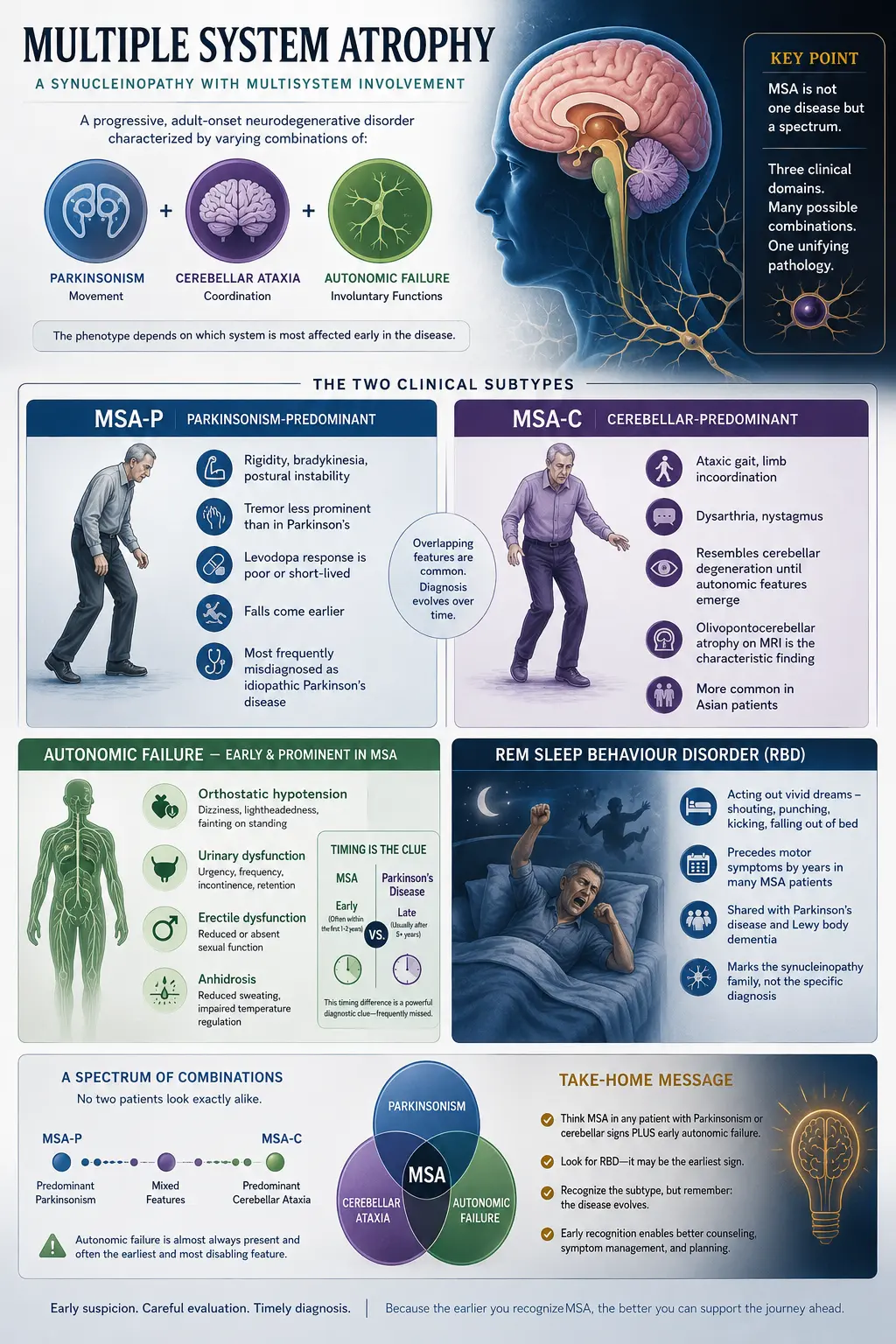
Diagnosis rests on clinical criteria plus MRI. The hot cross bun sign in the pons and putaminal rim sign are specific to MSA and absent in Parkinson’s disease. When these appear alongside early autonomic failure and poor levodopa response, the diagnosis is confirmed. That workup runs through the same Parkinson’s surgery and movement disorder evaluation used for all atypical Parkinsonism presentations.
How Is MSA Different From Parkinson’s Disease?
Same starting picture. Different biology, different prognosis, different treatment.
Levodopa response: Parkinson’s responds well, often dramatically in early years. MSA responds poorly or not at all, or shows a partial response that fades. A patient who doesn’t respond adequately to levodopa at appropriate doses doesn’t have typical Parkinson’s disease.
DBS ineligibility: DBS surgery works in Parkinson’s because the subthalamic and pallidal circuits remain intact. In MSA, those circuits degenerate, and stimulation finds no functional target. DBS is contraindicated in MSA. Referring for surgery before confirming the distinction exposes patients to operative risk without benefit.
Progression rate: Parkinson’s progresses slowly over decades. MSA progresses to wheelchair dependence rapidly, typically within five years, with dysphagia and respiratory compromise later. Median survival is seven to ten years from symptom onset versus near-normal life expectancy in treated Parkinson’s.
Pathology: Parkinson’s involves Lewy bodies in neurons. MSA involves glial cytoplasmic inclusions in oligodendrocytes. Same protein, alpha-synuclein, different cell type, different clinical behaviour. No disease-modifying treatment exists for either.
For how MSA sits alongside other alpha-synucleinopathies, particularly the distinction from Lewy body dementia, see Lewy body dementia.
How Is Multiple System Atrophy Managed?
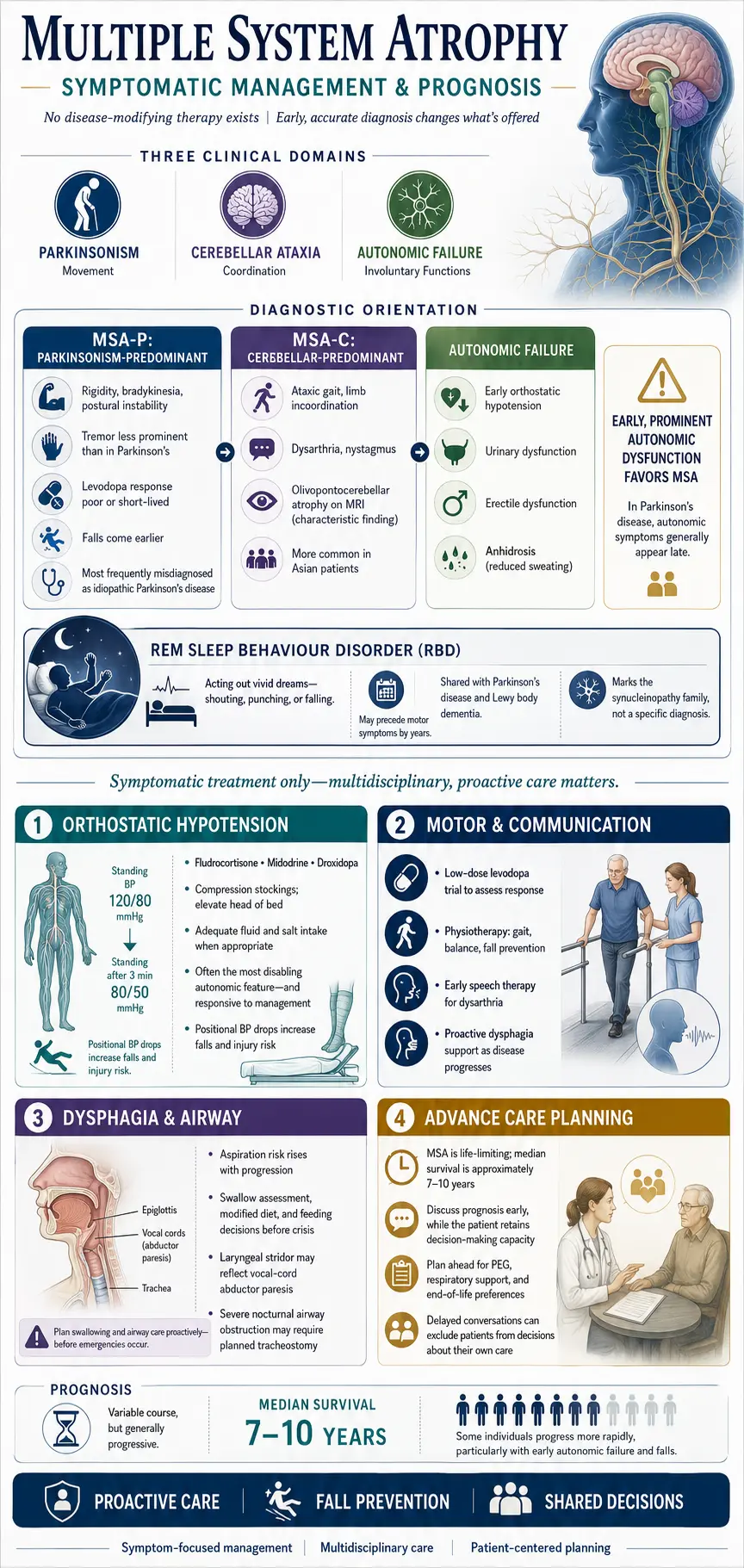
For the full clinical picture of Parkinson’s disease as the primary differential, see Parkinson’s disease symptoms.
Frequently Asked Questions
Is multiple system atrophy the same as Parkinson’s disease?
No. Both cause parkinsonism but MSA doesn’t respond to levodopa, progresses faster, and involves multiple neurological systems simultaneously.
Can MSA be treated with DBS surgery?
No. DBS is contraindicated in MSA the circuits DBS targets are themselves degenerating, so stimulation produces no benefit.
What is the life expectancy with multiple system atrophy?
Median survival is seven to ten years from symptom onset, significantly shorter than idiopathic Parkinson’s disease with treatment.
What makes MSA different from Lewy body dementia?
Both are alpha-synucleinopathies. MSA affects oligodendrocytes and spares cognition early. LBD involves neuronal Lewy bodies and produces early dementia.
References
Disclaimer: The information shared in this content is for educational purposes only and not for promotional use.