


Wondering if you’re actually a good candidate for a minimally invasive approach?
What Factors Influence Minimally Invasive Spine Surgery Success Rates?
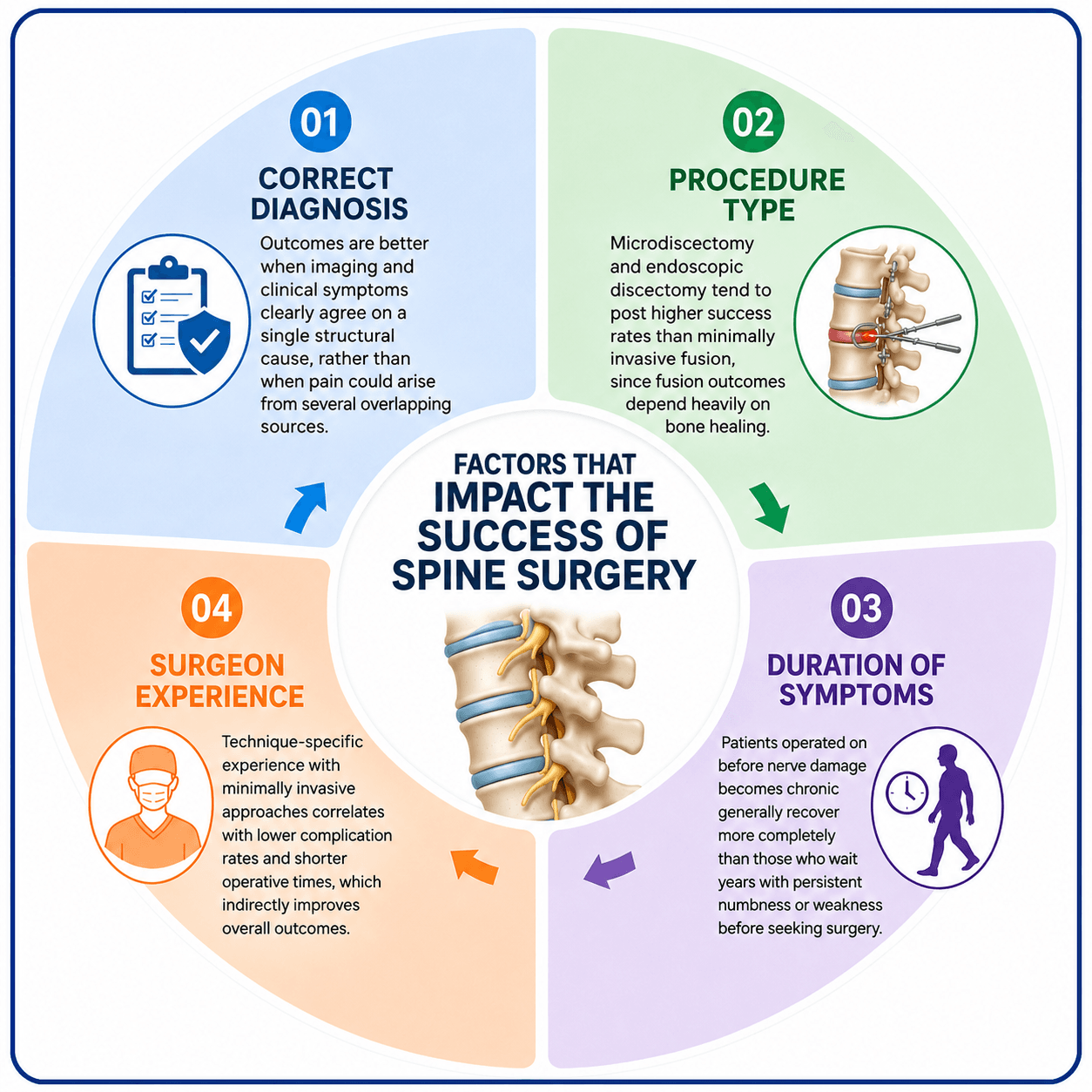
None of these factors work in isolation, and a strong result usually reflects several of them aligning rather than any single one.
These same selection principles guide broader decision-making across spine surgery, where matching the right procedure to the right patient drives most of the outcome difference.
How Do Success Rates Compare to Open Spine Surgery?
Minimally invasive and open techniques often achieve similar long-term symptom relief, but the path to get there looks different.
- Similar Long-Term Relief: for many common conditions, minimally invasive and open approaches show comparable success rates for pain relief at one and two years after surgery.
- Faster Early Recovery: the minimally invasive advantage shows up mainly in the first weeks, with less blood loss, smaller incisions and quicker return to daily activity than open surgery typically allows.
- Lower Complication Rates: infection and wound-related complications occur less often with minimally invasive techniques, largely due to smaller incisions and reduced tissue exposure during the procedure.
- Chronic Pain Support: Patients with lingering pain despite a technically successful surgery sometimes benefit from spinal cord stimulation, which manages residual nerve pain rather than addressing the original structural problem again.
Neither approach guarantees a perfect outcome, and the right comparison is always specific to the condition, not a blanket statement about one technique beating the other.
Patients preparing for surgery often want a realistic sense of the timeline involved, which is covered in recovery after minimally invasive spine surgery.
Why Choose Dr. Gurneet Singh Sawhney?
Dr. Gurneet Singh Sawhney brings 18 years of overall neurosurgical experience, including advanced fellowship training in functional neurosurgery and neuroendoscopy from Japan. Dr. Gurneet Singh Sawhney uses intraoperative spinal navigation and microscopic or endoscopic techniques to plan each minimally invasive procedure around the patient’s specific anatomy rather than a one-size-fits-all approach.
Patients who are properly screened before surgery consistently report better pain relief and faster return to normal activity than those rushed into a procedure without a clear structural diagnosis. That screening step is where most of the difference in outcome actually gets decided.
Frequently Asked Questions
Is minimally invasive spine surgery successful for everyone?
No, outcomes depend heavily on correct diagnosis and patient selection.
How soon can success be judged after surgery?
Meaningful improvement is usually assessed around six to twelve weeks post-surgery.
Does minimally invasive surgery have a lower failure rate than open surgery?
Not necessarily, long-term outcomes are often comparable between the two approaches.
Can success rates vary by spinal condition?
Yes, discectomy and fusion procedures have different expected success rates.
Reference:
- National Center for Biotechnology Information (NCBI) Surgical Outcomes of Minimally Invasive Techniques for Lumbar Interbody Fusion in India: A Systematic Review and Meta-Analysis
- National Center for Biotechnology Information (NCBI) Minimally Invasive versus Open Spine Surgery: What Does the Best Evidence Tell Us?
Disclaimer: The information shared in this content is for educational purposes only and not for promotional use.