

Camptocormia is severe forward trunk flexion at the thoracolumbar spine present on standing or walking, absent when lying flat. It’s involuntary. Patients cannot straighten up by trying. Disabling enough to impair walking, balance, and falls risk. Around ten percent of Parkinson’s patients develop it, but it also occurs in multiple system atrophy, dystonia, myopathy, and as a medication side effect. When it appears in a Parkinson’s patient, it raises the question of whether the diagnosis is right.
According to Dr. Gurneet Singh Sawhney, a neurosurgeon in mumbai, “Camptocormia in a Parkinson’s patient that appeared early, progressed quickly, and doesn’t respond to levodopa adjustment is a red flag for atypical Parkinsonism it changes the diagnostic conversation and the treatment plan.”
Severe forward trunk bending developing in a patient with Parkinson’s or movement disorder?
What Causes Camptocormia and How Is It Different From Normal Stooping?
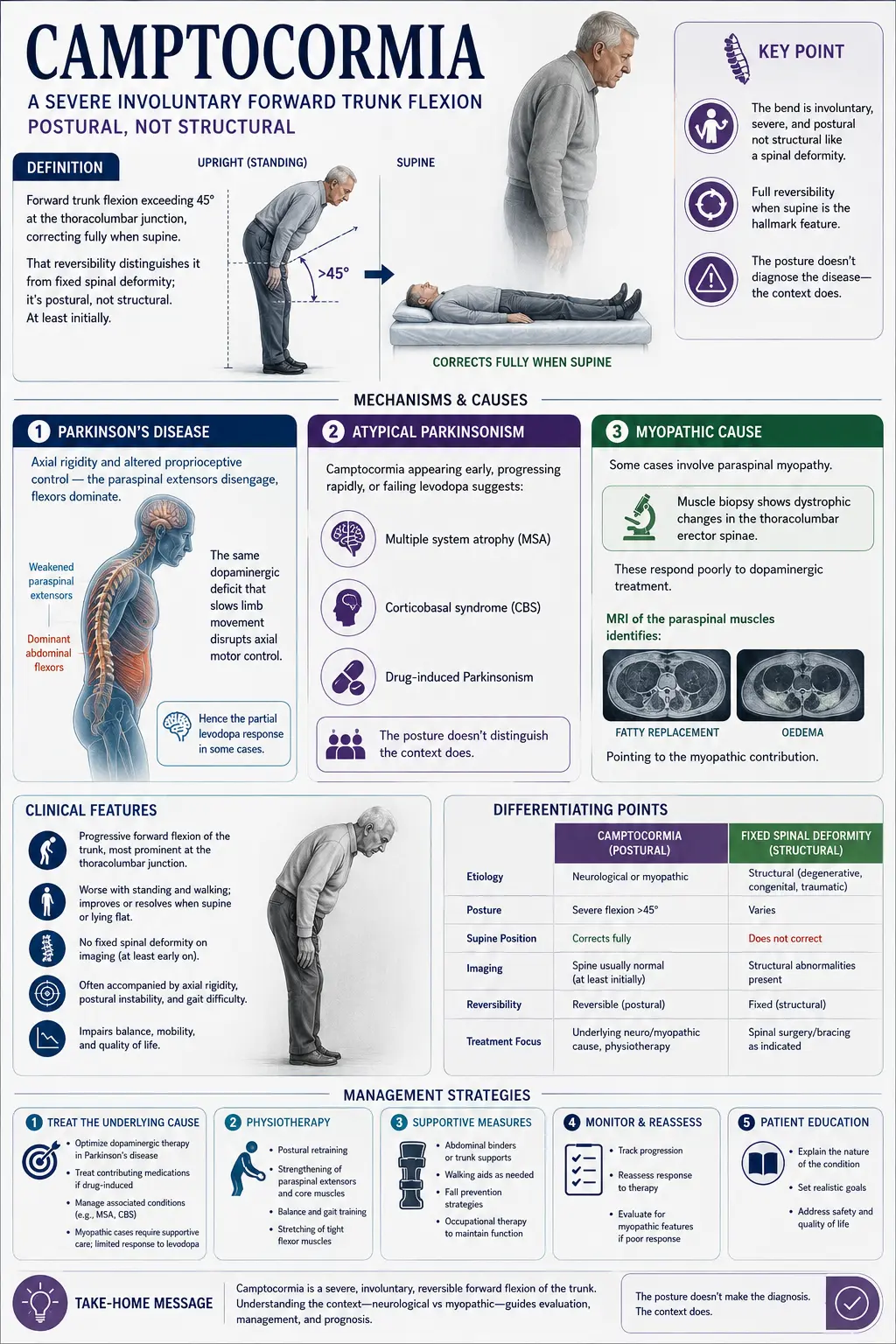
The workup crosses neurology and spine assessment imaging, paraspinal EMG, and levodopa challenge all contribute. This intersection sits within the Parkinson’s surgery movement disorder assessment framework.
How Is Camptocormia Managed in Parkinson’s Disease?
No single treatment works reliably. Response depends entirely on the underlying mechanism.
Levodopa optimisation: Partial responders exist trunk posture improves during the on-state. Adjust timing, frequency, or switch to extended-release to extend that window. Full correction with levodopa alone is uncommon.
Physiotherapy: Core activation, paraspinal strengthening, postural training. Slows progression and maintains residual capacity. Doesn’t reverse the neurological deficit.
Botulinum toxin: Effective when focal dystonia is the mechanism identifiable by abnormal EMG activity in hip flexors or abdominal muscles. Not effective for myopathic or pure Parkinsonian camptocormia.
DBS surgery: Subthalamic nucleus DBS surgery produces variable results less predictable than for limb tremor or rigidity. Better response when camptocormia clearly fluctuates with the on-off cycle, suggesting a dopaminergic rather than structural or myopathic mechanism.
Camptocormia alongside early falls, poor levodopa response, autonomic failure, or cerebellar signs should prompt diagnostic reassessment before committing to any treatment. “For the broader Parkinson’s disease picture and how atypical presentations differ from it, see Parkinson’s disease symptoms.”
What Are the Functional Consequences and Long-Term Outlook?
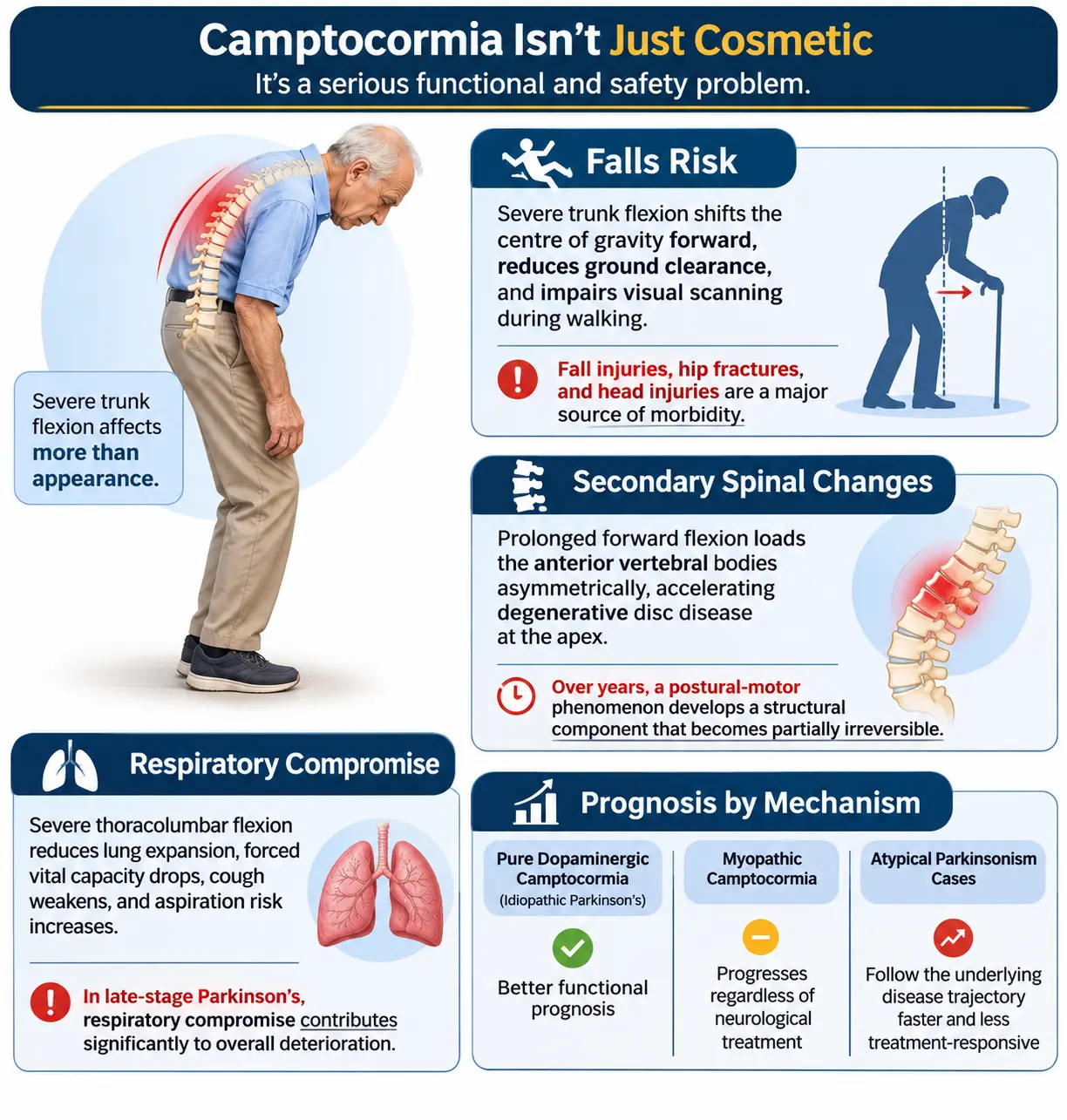
For balance and postural stability exercises addressing the functional impact of camptocormia, see Parkinson’s balance exercises.
Frequently Asked Questions
Is camptocormia always caused by Parkinson’s disease?
No. It occurs in MSA, dystonia, myopathy, and as a drug side effect. Parkinson’s is the most common context but not the only one.
Can camptocormia be reversed in Parkinson’s patients?
Partial improvement with levodopa optimization or DBS is possible in selected patients. Full reversal is uncommon.
What is the difference between camptocormia and normal Parkinson’s stooping?
Normal Parkinson’s stooping is mild and postural. Camptocormia is severe over 45 degrees involuntary, and disabling.
Does DBS surgery fix camptocormia in Parkinson’s disease?
Variable. Patients with clear on-off postural fluctuations respond better than those with a structural or myopathic mechanism.
References
Disclaimer: The information shared in this content is for educational purposes only and not for promotional use.