


Recovery speed after lumbar spine surgery depends on three things: the procedure performed, how long compression existed before surgery, and how closely the patient follows the rehabilitation protocol. Discectomy patients typically walk within 24 hours and return to desk work in 2–4 weeks. Fusion patients need at least six weeks before any loaded activity bone graft integration takes months regardless of how well the wound heals. Faster recovery isn’t about doing more; it’s about doing the right things at the right time.
According to Dr. Gurneet Singh Sawhney, spine surgeon in Mumbai, “The patients who recover fastest are almost always the ones who start walking early, don’t skip physiotherapy, and don’t push into pain not the ones trying to rush the timeline.”
Unsure what activities are safe in your first weeks after lumbar surgery?
What Should Patients Do in the First Two Weeks After Lumbar Spine Surgery?
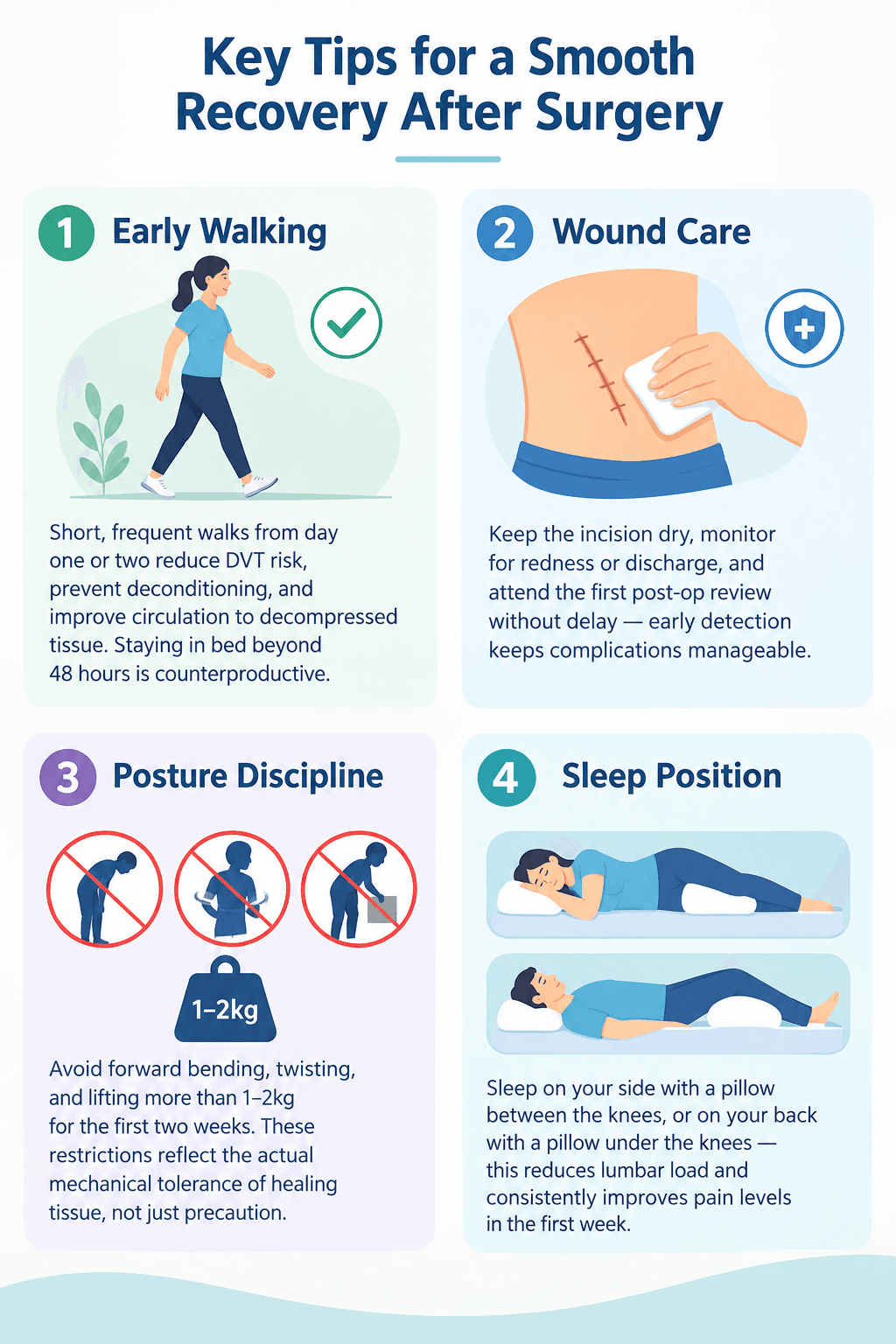
The early mobilisation approach mirrors what’s used in endoscopic spine surgery cases, where reduced tissue disruption means walking begins even earlier.
What Rehabilitation Steps Determine Long-Term Recovery Speed?
Physiotherapy and structured activity progression from week three onward is where recovery is won or lost:
- Physiotherapy: Core strengthening begins between weeks 3–6 depending on procedure type. Starting too early risks segment stress; delaying beyond six weeks allows deconditioning that significantly lengthens recovery.
- Return to sitting: Start with 20-minute intervals, increasing by 10 minutes daily. Patients who ignore sitting limits consistently report higher pain at the six-week review.
- Nerve recovery: Pre-operative neurological deficits weakness, foot drop, sensory loss follow their own timeline. Axonal regeneration proceeds at roughly 1mm per day, meaning functional return can take months even after technically successful surgery directly relevant to functional neurosurgery follow-up protocols.
- Activity escalation: Discectomy patients can typically drive at 2–3 weeks if not on opioids; fusion patients at 6–8 weeks. Skipping steps in this sequence is the most common cause of preventable setbacks.
Recovery responds to consistency, not intensity. For procedure-specific timelines and post-fusion milestones, see lumbar fusion recovery.
Why Choose Dr. Gurneet Singh Sawhney?
Dr. Gurneet Singh Sawhney holds MBBS, MS (General Surgery), and MCh (Neurosurgery) ranking first in the MCh university examination with cadaveric training in minimally invasive spine procedures, including tubular retractor and interlaminar endoscopic procedures, fellowship training in Functional Neurosurgery from Japan, and over 18 years of surgical experience managing lumbar discectomy, fusion, and complex revision spine cases.
Post-operative protocols in his practice are structured to the specific procedure performed not a generic recovery sheet because return-to-activity timelines that don’t account for what was actually done cause more preventable setbacks than most patients realise.
Frequently Asked Questions
How soon can patients walk after lumbar spine surgery?
Most patients begin walking on post-operative day one or two after standard lumbar procedures.
When does physiotherapy start after lumbar spine surgery?
Core strengthening physiotherapy typically begins between weeks three and six depending on the procedure.
Does nerve pain resolve immediately after lumbar decompression surgery?
Not always nerve recovery after chronic compression can take weeks to months post-operatively.
When can patients return to desk work after lumbar spine surgery?
Discectomy patients typically return in two to four weeks; fusion patients require six weeks minimum.
Disclaimer: The information shared in this content is for educational purposes only and not for promotional use.