

Cardiac Rehabilitation Therapy in Mumbai
Cardiac rehabilitation is a structured, medically supervised programme that helps the heart and body recover after a heart attack, heart surgery, or a diagnosis of heart failure. It combines monitored exercise, lifestyle guidance, and ongoing risk-factor management to rebuild stamina and protect against future cardiac events, usually over several weeks to a few months.
According to Dr. Rameet Kaur Sawhney, Cardiac Rehabilitation Specialist in Mumbai, “Surviving a cardiac event is only the beginning. Structured, supervised rehabilitation is what turns that survival into a patient who walks, works, and lives with real confidence again.”
Dr. Rameet Kaur Sawhney is a Senior Cardiorespiratory Rehabilitation Physiotherapist with over 18 years of experience, holding a BPT, MPT (CVTS), MIAP, and a Fellowship in Cardiac Rehabilitation. She leads The Heart Rehab in Mulund West, Mumbai, where she designs evidence-based, phase-wise recovery programmes for patients recovering from heart attacks, cardiac surgery, and chronic heart conditions.
Here’s the truth most people don’t hear early enough. Surviving a heart attack or coming through bypass surgery is only the first step. The heart muscle, like any other muscle, needs guided retraining to regain strength safely. Skip that step, and patients are left deconditioned, anxious about exertion, and at higher risk of a repeat event.
It helps to know what makes cardiac rehabilitation different from general fitness training. A gym programme assumes a healthy heart. Cardiac rehab assumes the opposite, and builds exercise intensity around what a recovering heart can safely tolerate, with monitoring built in at every stage.
Read on to understand who needs cardiac rehabilitation, how the programme is structured, what a session looks like, and why Dr. Rameet Kaur Sawhney’s evidence-based approach at The Heart Rehab stands apart.
Ready to Rebuild Your Strength Safely? A personalized cardiac rehab plan from an experienced, fellowship-trained specialist can help you recover stamina and confidence with the right level of supervision.
Who Needs Cardiac Rehabilitation Therapy in Mumbai?
Cardiac rehabilitation supports recovery across a range of heart conditions and procedures. It works alongside cardiology care and medication, never in place of them. Every programme at The Heart Rehab is built around the patient’s specific event and risk profile.
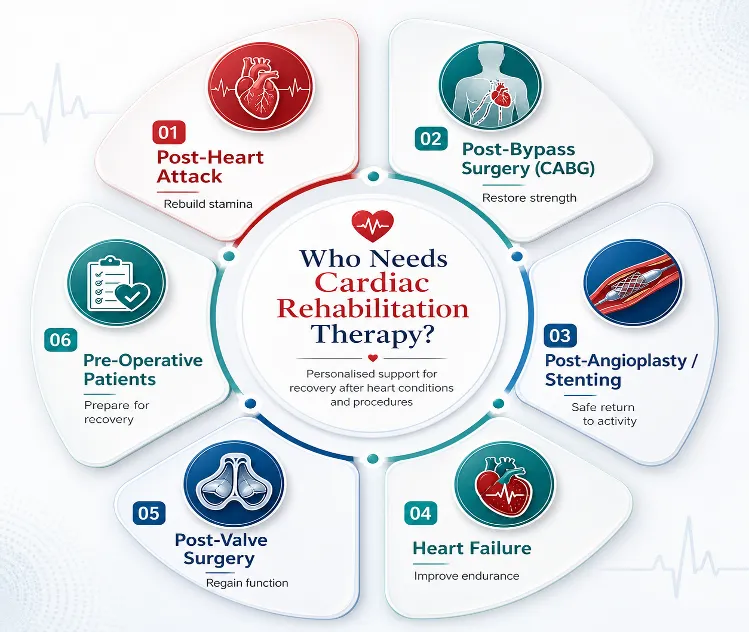
Post-Heart Attack (Myocardial Infarction):
Supervised exercise rebuilds cardiovascular stamina and confidence after the heart muscle has been damaged.
Post-Bypass Surgery (CABG):
Structured mobilisation restores strength and lung capacity while protecting the healing chest and graft sites.
Post-Angioplasty or Stenting:
Guided activity helps patients safely return to normal exertion levels after a coronary intervention.
Heart Failure:
Carefully paced exercise improves stamina and quality of life without overloading a weakened heart.
Post-Valve Surgery:
Rehab restores functional capacity while respecting the specific precautions of valve repair or replacement.
Pre-Operative Patients:
Pre-op counselling and conditioning help patients enter cardiac surgery stronger and better prepared for recovery. This kind of pre-op conditioning is equally valuable for patients also undergoing major elective procedures such as spine or brain surgery, where combined cardiac and surgical clearance smooths the path to recovery.
Each condition needs its own protocol, paced against what the healing heart can safely take on. That’s exactly why a supervised, specialist-led plan matters more than a generic exercise routine.
Post-Surgical Cardiac Rehabilitation
Recovery after bypass surgery or valve surgery isn’t automatic. Patients who begin structured, supervised activity early regain stamina faster and face fewer complications like deconditioning or breathlessness on exertion. Early rehab also protects the surgical site, with intensity and movement built around exactly what the healing chest and heart can tolerate at each stage, an approach that mirrors how recovery is paced after other major surgeries.
Rehabilitation After a Heart Attack
A heart attack often leaves patients anxious about physical activity, afraid that exertion will trigger another event. Monitored cardiac rehab addresses both the physical and psychological sides of recovery, rebuilding tolerance for exercise gradually while giving patients the confidence that comes from being safely monitored throughout.
Our Services at The Heart Rehab
Dr. Rameet Kaur Sawhney and her team offer a comprehensive range of cardiac and pulmonary rehabilitation services, tailored to each patient’s stage of recovery:
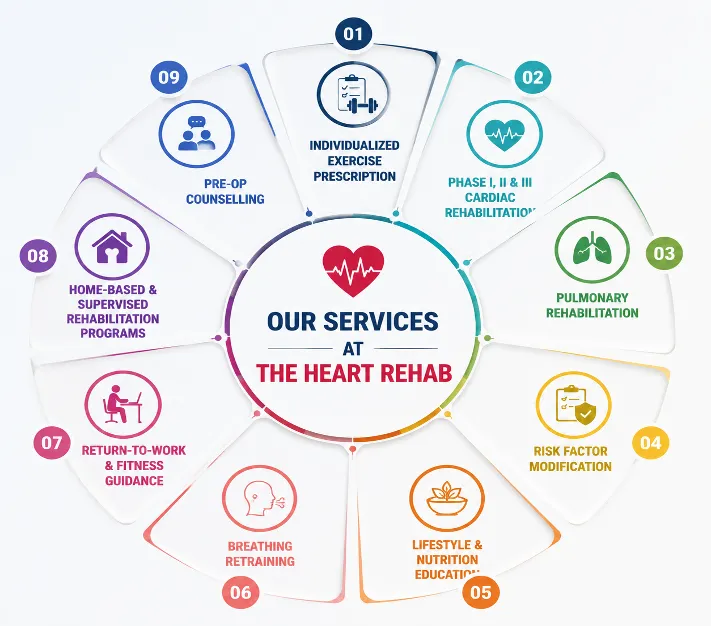
1. Individualized Exercise Prescription
2. Phase I, II & III Cardiac Rehabilitation
3. Pulmonary Rehabilitation
4. Risk Factor Modification
5. Lifestyle & Nutrition Education
6. Breathing Retraining
7. Return-to-Work & Fitness Guidance
8. Home-Based & Supervised Rehabilitation Programs
9. Pre-Op Counselling
How Cardiac Rehabilitation Treatment Works
Treatment starts with a full cardiac and functional assessment, covering heart function, exercise tolerance, and individual risk factors. From there, the plan is built in phases, moving from closely supervised sessions to independent, long-term maintenance.
The Role of Gradual Reconditioning in Recovery
A recovering heart adapts the same way any muscle does, through consistent, progressively increasing demand. Pushing too hard too soon raises risk, while too little activity leaves patients deconditioned and more vulnerable to future events. Structured cardiac rehab finds that middle path, increasing intensity only as the heart demonstrates it can handle it.
Tracking Progress and Adjusting the Plan
A good cardiac rehab plan is never frozen. Progress is reassessed at regular intervals, tracking exercise capacity, blood pressure response, and everyday milestones like climbing stairs or walking a set distance without breathlessness. If progress stalls or new symptoms appear, the plan is adjusted immediately, always erring on the side of caution with a recovering heart.
Start Your Recovery the Right Way. A structured, phase-wise programme paced to your heart’s recovery reduces risk and builds lasting stamina, not a one-size-fits-all workout.
What to Expect During Your Sessions
Knowing what actually happens in a session takes away a lot of the anxiety around exercising after a cardiac event. Cardiac rehabilitation at The Heart Rehab is structured, monitored, and always paced to what your heart can safely manage that day.
When Should Cardiac Rehabilitation Begin?
Timing matters. After a heart attack, bypass surgery, or valve procedure, cardiac rehab typically begins once the treating cardiologist confirms the patient is medically stable, often within one to a few weeks of the event or discharge. Starting in this early window has been consistently linked to better long-term outcomes and a lower risk of hospital readmission.
That said, it’s rarely too late to start. Patients who are months out from their cardiac event can still gain meaningful improvements in stamina, strength, and confidence through a well-supervised programme.
Why Choose Dr. Rameet Kaur Sawhney for Cardiac Rehabilitation in Mumbai?

Dr. Rameet Kaur Sawhney is a Senior Cardiorespiratory Rehabilitation Physiotherapist with 18+ years of experience, holding a BPT, MPT (CVTS), MIAP, and a Fellowship in Cardiac Rehabilitation. As the founder of The Heart Rehab in Mulund West, she has built her practice around evidence-based rehabilitation protocols that improve exercise capacity, reduce hospital readmissions, and restore patients’ confidence in their long-term heart health.
Her programmes cover the full continuum of cardiac recovery, from Phase I, II, and III cardiac rehabilitation to pulmonary rehabilitation, risk-factor modification, and pre-op counselling, delivered through both home-based and supervised in-clinic sessions.
Patients can consult Dr. Rameet Kaur Sawhney at The Heart Rehab, C118–C131, Hallmark Commercial Complex, LBS Road, Mulund West, Mumbai – 400080, for a personalised, evidence-based cardiac rehabilitation plan tailored to their specific condition, procedure, and stage of recovery.
Don’t Let a Cardiac Event Hold Your Recovery Back. Consult Dr. Rameet Kaur Sawhney at The Heart Rehab for a personalised, evidence-based recovery plan built around your condition and stage of healing.
Frequently Asked Questions
1. What is cardiac rehabilitation used for?
It rebuilds strength, stamina, and confidence after a heart attack, heart surgery, or a diagnosis of heart failure, while lowering the risk of future cardiac events.
2. How long does cardiac rehabilitation take to work?
Most patients see measurable gains in stamina and exercise tolerance within six to twelve weeks of consistent, supervised therapy.
3. Is cardiac rehabilitation safe after a heart attack?
Yes, Sessions are closely monitored, with intensity built around what your heart can safely tolerate at each stage of recovery.
4. Can cardiac rehabilitation help after bypass or valve surgery?
Yes, structured, supervised activity speeds recovery of stamina and function while respecting the specific precautions of your surgery.
5. Who needs cardiac rehabilitation?
Patients recovering from a heart attack, bypass surgery, angioplasty or stenting, heart failure, or valve surgery benefit most, along with those preparing for cardiac surgery through pre-op counselling.
References
- World Health Organization, Cardiovascular Diseases: int/health-topics/cardiovascular-diseases
- American Heart Association, Cardiac Rehabilitation: heart.org/en/health-topics/cardiac-rehab
Blogs
Do They Shave Your Head for Brain Surgery?
Not necessarily. Whether hair is removed during brain surgery depends on the type of surgery, the incision site, and the technique used. Today, shave-free surgery is increasingly preferred and recommended wherever it can be done safely. Many patients have only a patch...
Life After Brain Tumor Surgery: Recovery Timeline
Understanding brain tumours early can help patients make informed decisions about diagnosis and treatment. Timely medical evaluation, personalised treatment, and regular follow-up are key to managing the condition and supporting better outcomes.
What Causes Levodopa-Induced Dyskinesia in Parkinson’s?
Understanding brain tumours early can help patients make informed decisions about diagnosis and treatment. Timely medical evaluation, personalised treatment, and regular follow-up are key to managing the condition and supporting better outcomes.