

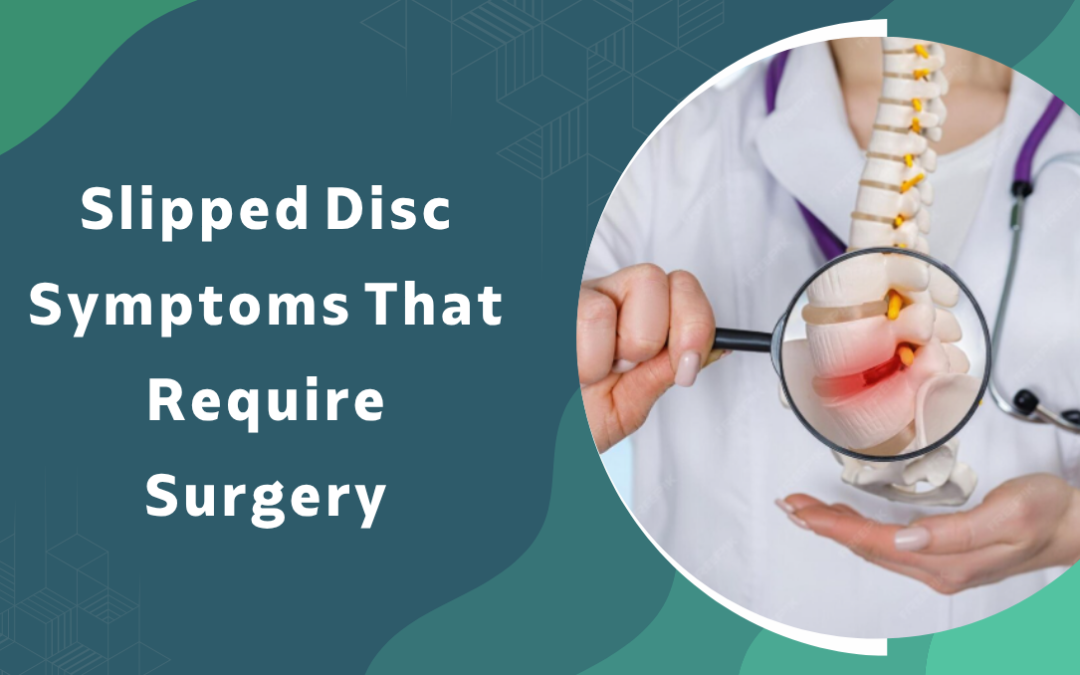
Most slipped discs resolve without surgery over six to twelve weeks with physiotherapy and pain management. Surgery becomes necessary when neurological deficit is progressing, conservative management has genuinely failed after six weeks, or specific red flag symptoms appear that cannot wait. Pain severity alone is never the deciding factor. What matters is whether nerve or cord function is being compromised and whether that compromise is getting worse.
According to Dr. Gurneet Singh Sawhney, Neurosurgeon in Mumbai, “the patients who genuinely need surgery for a slipped disc are a minority, but they’re also the ones who lose the most by waiting too long to find out they’re in that group.”
Experiencing leg or arm weakness alongside your disc pain that isn’t improving?
Which Slipped Disc Symptoms Actually Need Surgery?
Specific neurological findings change the management entirely.
- Progressive motor weakness: Foot drop appearing over days and still worsening, grip strength declining week on week, inability to lift the arm against gravity that wasn’t there two weeks ago. These aren’t pain symptoms. They’re nerve function symptoms and waiting for six weeks of physiotherapy while motor function actively deteriorates is the wrong plan because recovery after decompression is directly tied to how long the deficit was present before surgery.
- Cauda equina syndrome: Bilateral leg weakness, saddle anaesthesia around the perineum, and any change in bladder or bowel function together constitute a neurosurgical emergency requiring same-day MRI and surgical decompression within hours. This is the one slipped disc presentation where hours genuinely matter and patients researching spine surgery in Mumbai should know it cold before they need it.
- Failed conservative management with confirmed compression: Six weeks of properly supervised physiotherapy, adequate pain management, activity modification, none of it working, and MRI confirming disc prolapse compressing the nerve root that matches exactly what the patient is experiencing clinically. At this point surgery is a reasonable and evidence-supported option. Not mandatory. But reasonable.
- Intractable pain preventing any function: Severe radicular pain that hasn’t responded to any conservative measure including nerve root injection, that prevents sleep, standing, or any meaningful daily activity over weeks. This is the softest surgical indication of the four but it exists and it’s real for a subset of patients who’ve exhausted every non-surgical option properly.
Most disc prolapses resorb over time without surgery. But some don’t and some patients can’t wait.
Explore best spine surgeon in Mumbai for disc prolapse evaluation at Fortis Hospital Mulund West.
What Symptoms Don't Require Surgery?
Understanding this matters as much as knowing what does.
- Back pain alone: A slipped disc causing only local back pain without radiation down the leg or arm, without any neurological deficit, and without red flag symptoms has no surgical indication regardless of how severe the pain is. Back pain from disc prolapse responds to physiotherapy, activity modification, and time. Surgery on back pain alone produces reliably poor outcomes.
- Radicular pain without deficit: Shooting leg pain from disc pressing on nerve root, the classic sciatica pattern, without motor weakness or sensory loss. Painful. But not a surgical emergency. The majority of these resolve over six to twelve weeks. Nerve root compression without motor deficit is managed conservatively first in all but the most severe functional impairment cases.
- Disc changes on MRI without matching symptoms: Bulging discs, mild protrusions, degenerative disc disease findings on imaging in a patient whose symptoms don’t match the level or distribution on the scan. These findings exist in a significant proportion of the asymptomatic adult population. Operating on them because the MRI looks abnormal is how failed back surgery syndrome happens.
- Acute disc prolapse in the first six weeks: Unless neurological deficit is progressing or red flag symptoms are present, most guidelines support a minimum six-week trial of conservative management before surgical referral is appropriate for a new acute disc prolapse.
Clinical findings and imaging must tell the same story before surgery is the right answer.
Read about whether neurological problems can exist with normal scans to understand why the examination matters as much as the MRI.
Why Choose Dr. Gurneet Singh Sawhney?
Dr. Gurneet Singh Sawhney trained in functional neurosurgery under Prof. Taira at Tokyo Women’s Medical University and epilepsy surgery under Prof. Sugano at Juntendo University, two dedicated subspecialty fellowships at high-volume Asian centres. At Fortis Hospital Mulund West, every disc prolapse case gets full neurological examination, MRI correlation, and an honest answer about whether surgery adds anything for that specific patient.
Some patients arrive having already been told they need surgery. After examination and imaging review, some do and some don’t. Some arrive having been told to keep doing physiotherapy when the clinical picture has long since crossed into surgical territory. Getting that call right is the whole job. Call +91 8104310753 to book your consultation.
FAQ's
What slipped disc symptoms require surgery?
Progressive motor weakness, cauda equina syndrome, failed conservative management after six weeks, or intractable pain unresponsive to all non-surgical treatment.
Does a slipped disc always need surgery?
No, most disc prolapses resolve with physiotherapy and pain management over six to twelve weeks without surgical intervention.
Is sciatica alone a reason for disc surgery?
No, radicular leg pain without motor weakness is managed conservatively first and most cases resolve without surgery.
What is the most urgent slipped disc symptom requiring emergency surgery?
Cauda equina syndrome with bilateral leg weakness, saddle anaesthesia, and bladder or bowel dysfunction requires same-day MRI and surgery within hours.
References
- National Institute of Neurological Disorders and Stroke. Neurological Diagnostic Tests and Procedures. NINDS, NIH.
- Deyo RA, et al. Back Pain and Surgery. PubMed Central, NCBI.