
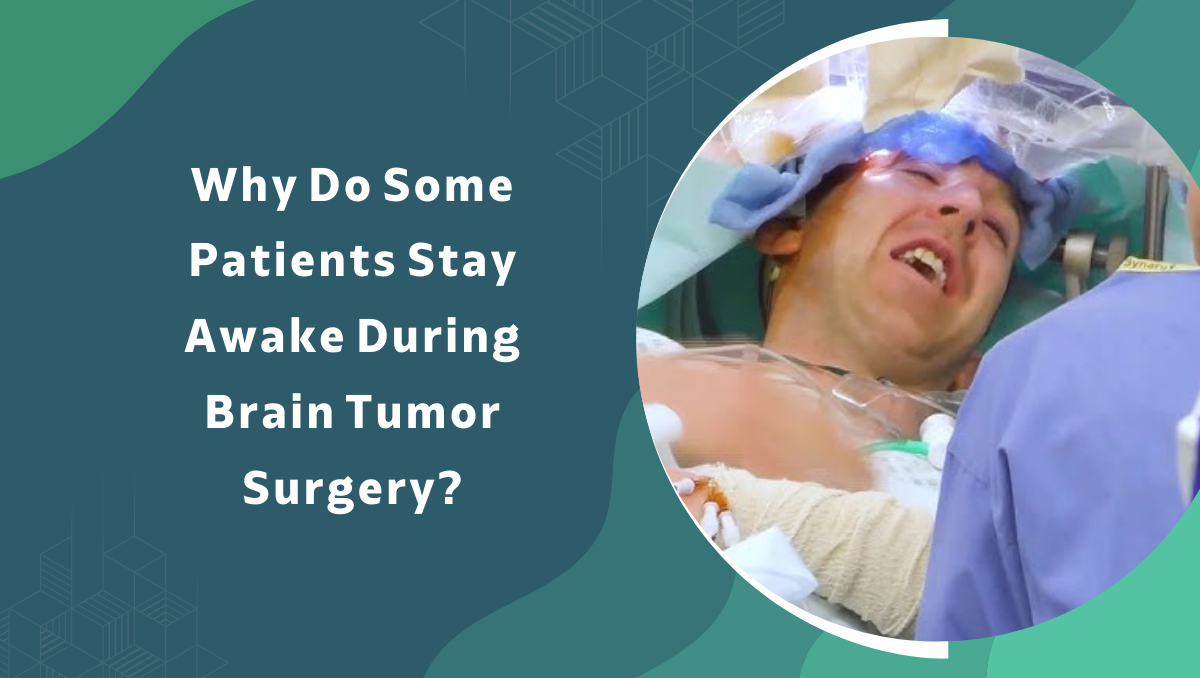
It sounds like the most frightening thing imaginable. It isn’t but that’s not a sentence that lands well without explanation.
Certain brain tumors grow right next to areas that handle speech, language, movement. Remove the tumor under general anaesthesia and you have no way of knowing, in real time, whether you’re cutting into something that shouldn’t be cut. The patient can’t tell you. The brain can’t tell you. Imaging helps but it doesn’t update as you go. So for these cases not all cases, specific ones the patient stays awake during part of the procedure. They answer questions. Name objects. Move a hand when asked. And those responses tell the surgeon exactly where to stop. That’s the whole logic. Frightening on paper. Remarkably controlled in practice.
Dr. Gurneet Singh Sawhney is a neurosurgeon at Fortis Hospital Mumbai with 18 years of complex neurosurgical practice and a fellowship in functional neurosurgery from Japan. Awake craniotomy is part of his surgical practice for tumors where real-time feedback changes what’s safely removable.
Trying to understand what brain tumor surgery actually involves for your case?
What Actually Happens During Awake Brain Tumor Surgery
Not what most people picture. Worth knowing the actual sequence.
The uncomfortable parts happen while you’re sedated: The scalp incision. Bone removal. All of that happens under sedation with local anaesthesia numbing the scalp properly. Nobody is conscious for the parts that would be distressing. Once the brain is exposed and this is the part people don’t expect sedation gets reduced and the patient wakes up. The brain has no pain receptors. Lying still for a couple of hours is uncomfortable. The surgery itself isn’t painful.
Mapping is what the awake phase is actually for: A small electrode touches different points on the brain surface. Each stimulation briefly disrupts whatever that area does. The neuropsychologist in the room runs structured tasks name this picture, count backward, squeeze your hand. If a stimulation makes the word disappear, or the hand stiffen, that area gets marked. Resection stops before those boundaries. Patients already looking into brain tumor surgery in Mumbai are often surprised the mapping phase typically runs under two hours for most cases. It feels longer in the imagination than it is on the table.
The tasks aren’t random they’re designed around your specific tumor: A frontal lobe tumor near motor cortex and a temporal lobe tumor near language processing need completely different tasks. The neuropsychologist tailors the exercise set to what’s actually at risk for that case. Families who’ve already read about whether neurological problems can exist with normal scans usually come in already understanding that imaging has real limits in functional mapping. This is where those limits get addressed.
Should Every Brain Tumor Patient Have Awake Surgery
No. But for certain cases the alternative is genuinely riskier than the awake procedure.
Location decides it more than anything else: A tumor sitting in a non-eloquent area away from the motor strip, away from language pathways can come out under general anaesthesia without the same stakes. But when the tumor is near Broca’s area, Wernicke’s area, the motor cortex, or major white matter tracts real-time patient response fills a gap that fMRI and tractography can identify but can’t close. There’s always some distance between what a functional scan shows and what actually happens when a surgical instrument moves through tissue. Awake mapping closes that gap.
General anaesthesia isn’t automatically the conservative choice: This is where families sometimes get the logic backwards. For eloquent cortex tumors, operating asleep means removing less tumor to stay safe or accepting a higher chance of waking up with something permanently lost. Speech. Hand movement. Word retrieval. Things that don’t come back. The real comparison isn’t between awake surgery and comfortable surgery. It’s between awake surgery and a worse expected outcome from the same operation done without real-time feedback.
Not every patient is a practical candidate: Severe anxiety, difficulty cooperating with tasks, certain cognitive or language impairments before surgery these can make awake craniotomy technically impractical even when the tumor location would otherwise call for it. The pre-surgical assessment covers this. It’s not just about whether the case needs awake mapping. It’s about whether this specific patient can hold up their end of it for two hours.
As a Neurosurgeon in Mumbai who performs awake craniotomies for tumors in eloquent brain regions, Dr. Sawhney’s planning runs through fMRI, tractography, neuropsychological baseline, and patient suitability before any surgical approach gets decided not after.
Why Choose Dr. Gurneet Singh Sawhney
Awake craniotomy is technically demanding in ways that compound quickly if anything in the preparation is skipped.
Dr. Sawhney trained under Prof. Taira at Tokyo Women’s Medical University for functional neurosurgery and under Prof. Sugano at Juntendo University for epilepsy surgery. Two full fellowships at centres doing intracranial work at real volume. Back at Fortis Hospital Mulund West, every brain tumor case near the eloquent cortex goes through proper pre-surgical functional mapping before the operating approach is fixed. The awake craniotomy protocol involves a dedicated neuroanesthesiologist and neuropsychologist alongside the surgical team not assembled on the day. Families come in having already decided the awake part sounds impossible. Most leave the pre-surgical consultation understanding exactly what they’ll experience, what the team is doing during the awake phase, and why it gives their case a better shot at a clean outcome than the alternative. That conversation is worth having early.
FAQ's
Why do surgeons keep some brain tumor patients awake during surgery?
Tumors near speech, language, or motor areas need real-time patient feedback during removal the only way to confirm the resection isn’t crossing into critical functional tissue while it’s actually happening.
Does awake brain surgery hurt?
No the scalp is numbed with local anaesthesia and the brain itself has no pain receptors, so the awake phase involves some discomfort from lying still rather than pain from the surgery itself.
How long is the awake part of a craniotomy?
Typically one to two hours for most cases depending on how much cortical mapping is needed the opening and closure happen under sedation on either side of that window.
Can every patient with a brain tumor near speech areas have awake surgery?
Not always severe anxiety, difficulty cooperating with tasks, or certain pre-existing cognitive issues can make awake craniotomy impractical even when the tumor location would otherwise call for it.
How do I arrange a consultation with Dr. Gurneet Singh Sawhney about brain tumor surgery in Mumbai?
Call +91 8104310753 or email gurneetsawhney@gmail.com he reviews imaging and records before the appointment at Fortis Hospital, Mulund West, Mumbai, so the surgical approach discussion is based on your actual case.
References
- National Institute of Neurological Disorders and Stroke. Neurological Diagnostic Tests and Procedures. NINDS, NIH.
- Doraiswamy S, et al. Use of Digital Technologies in Facilitating Healthcare Access. PubMed Central, NCBI.