
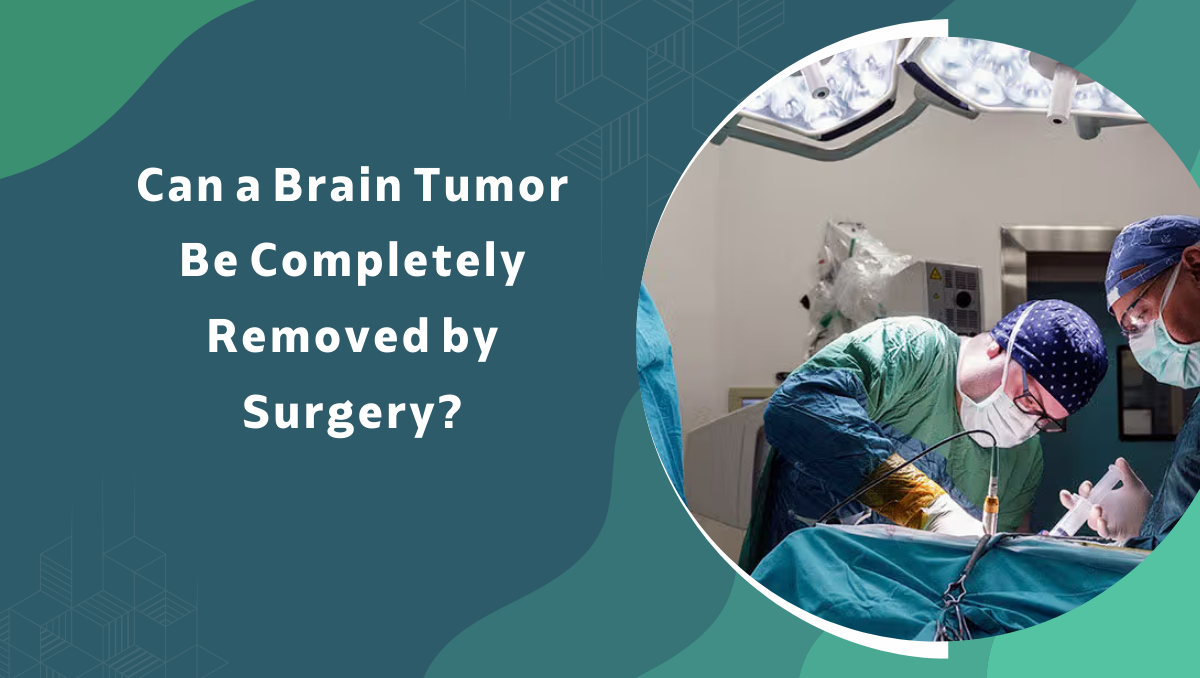
Depends entirely on what kind of tumor you’re dealing with. That’s not a dodge, it’s genuinely the answer.
Two patients, two brain tumors, two completely different surgical realities. One has a meningioma sitting on the brain surface with clean edges. The other has a glioblastoma with tumor cells threading through tissue in every direction. The first one surgery can take it out entirely. The second no surgeon in the world can follow every cell without destroying what’s around them. Same operation, different disease, different outcome. And anyone who gives you a single answer without knowing which tumor you have is guessing.
Dr. Gurneet Singh Sawhney is a neurosurgeon at Fortis Hospital Mumbai with 18 years managing brain tumors at every grade. His answer to this question always starts with the scan not a general statement.
Want to know what’s actually achievable for your specific tumor?
Tumors Where Complete Removal Is Genuinely Possible
Not all of them. But more than people assume.
Meningiomas the clearest case for full removal: These grow from the brain’s outer lining, not from inside brain tissue. They push rather than infiltrate. That matters surgically there’s an actual boundary to work with. A well-positioned meningioma, fully resected, has low recurrence and often needs nothing after surgery. Gross total resection rates above 90 percent at experienced centres aren’t unusual for accessible cases. Not every meningioma sits somewhere convenient skull base meningiomas near cranial nerves are a different challenge. But for the ones that do, complete removal is the expected outcome, not an ambitious one. Patients looking into brain tumor surgery in Mumbai find that resection rates at dedicated neurosurgical centres here compare well internationally for these cases.
Pituitary tumors and acoustic neuromas: Pituitary adenomas often come out entirely through the nose. No craniotomy, no scalp incision, no bone removal. The endonasal approach has transformed these cases recovery is faster, resection is often complete. Acoustic neuromas on the vestibular nerve are similar; the goal is full removal with facial nerve and hearing preservation where possible. For both, surgery at the right centre with the right team produces complete resection far more often than not.
Low-grade gliomas are more complicated but extent still matters: These don’t have clean edges. They grow from within brain tissue and there’s no capsule to remove cleanly. But they’re slower, less aggressive, and the extent of resection directly affects how long before the tumor returns. Getting more out means longer before progression. Where the tumor sits near motor or language areas, awake craniotomy pushes resection further safely. Families who’ve read about whether neurological problems can exist with normal scans already understand why post-operative imaging tracking matters here: resection extent documented, then followed.
When Complete Removal Simply Isn't the Goal
Glioblastoma infiltrative, no real margin: GBM doesn’t declare its edges. Tumor cells spread into apparently normal tissue well beyond what any MRI shows. Surgery removes the visible bulk. It improves survival and quality of life compared to biopsy alone. But it isn’t curative. It can’t be. The cells left behind invisible on imaging drive recurrence. Maximal safe resection is the operative phrase. Not complete removal. Maximum safety.
Location sometimes overrides everything: A tumor resectable in one part of the brain becomes untouchable in another. Brainstem. Thalamus. Deep basal ganglia. Going after every cell in these locations means damaging what’s around them permanently. The trade isn’t worth it. In these cases the surgical goal shifts remove what’s safely removable, relieve pressure, preserve function.
As a Neurosurgeon in Mumbai who has operated across this full range, Dr. Sawhney’s pre-surgical conversation is specific what this tumor allows, what this location allows, what the realistic outcome is.
Why Choose Dr. Gurneet Singh Sawhney
The millimetres between complete resection and incomplete resection near language cortex, near motor strip are where subspecialty training shows.
Dr. Sawhney trained under Prof. Taira at Tokyo Women’s Medical University for functional neurosurgery. Under Prof. Sugano at Juntendo University for epilepsy surgery. Two proper fellowships at centres doing this at real volume. Back at Fortis Hospital Mulund West, every brain tumor case goes through functional MRI, tractography where it matters, neuropsychological baseline before the approach is fixed. Awake craniotomy is available for the cases that need it. And the resection conversation is honest what’s achievable for that tumor, in that location, for that patient. Families come in asking whether the tumor can be removed completely. They leave with an answer that actually means something.
FAQ's
Can all brain tumors be fully removed with surgery?
No benign tumors like meningiomas often can be, but infiltrative tumors like glioblastoma can’t because tumor cells spread beyond visible margins into surrounding tissue.
What is gross total resection?
It means all visible tumor on imaging was removed it doesn’t mean no microscopic cells remain, which is why adjuvant treatment and surveillance imaging follow most glioma surgeries.
Does tumor location affect whether complete removal is possible?
Yes a tumor fully removable in one area may be untouchable in another; brainstem and deep structure tumors often require partial resection to avoid permanent neurological damage.
Is surgery worth doing if complete removal isn't possible?
Yes partial resection still reduces tumor bulk, relieves pressure, improves symptoms, and gives adjuvant therapy a better starting point than biopsy or no surgery.
How do I consult Dr. Gurneet Singh Sawhney about brain tumor removal in Mumbai?
Call +91 8104310753 or email gurneetsawhney@gmail.com he reviews imaging before the consultation at Fortis Hospital, Mulund West, Mumbai, so the resection discussion is specific to your case.
References
- National Institute of Neurological Disorders and Stroke. Neurological Diagnostic Tests and Procedures. NINDS, NIH.
- Doraiswamy S, et al. Use of Digital Technologies in Facilitating Healthcare Access. PubMed Central, NCBI.